

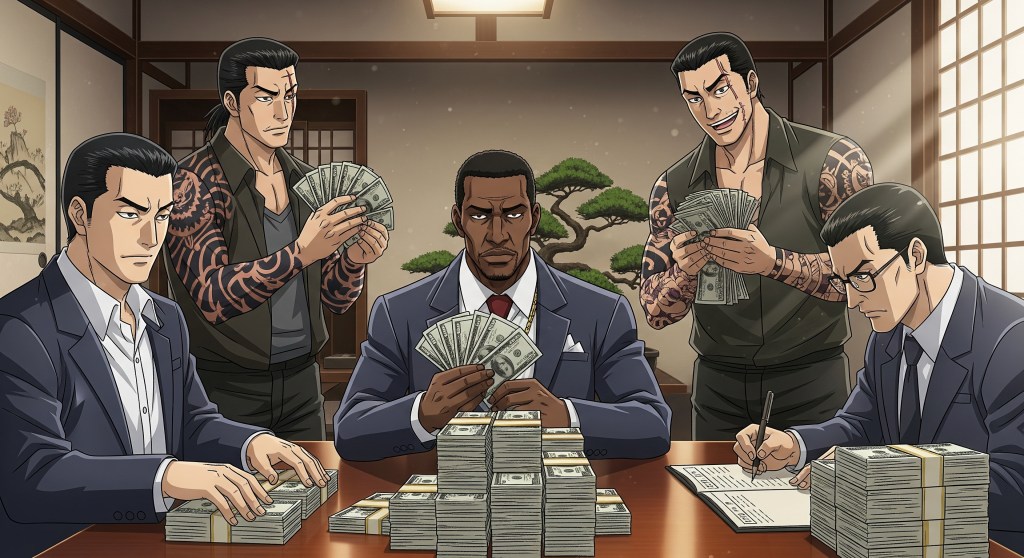
とりひき を おわらせて、 そして かね を かぞえた。
Torihiki o owarasete, soshite kane o kazoeta.
We finished the deal, and then counted the money.
Picture this: You got a story to tell. Maybe it’s ’bout the last score you pulled, or a night out with your crew. You need to connect one thing to the next, right? That’s where these words come in.
そして (soshite) is the homie you call when you’re adding on to a story, like stacking up dough. It’s for when you’re moving from one action to the next, but it can also be used to connect ideas that ain’t in a strict time order. It’s like, “I hit the bank, and then I bought a new suit.” It’s smooth, it’s cool, it’s just continuin’ the flow. It can also be used to add more info about something you just said. Like, “The boss is smart, and also ruthless.” It’s more versatile, like a switchblade.
それから (sorekara), on the other hand, is the real timekeeper of the crew. This one is all about strict chronological order. It’s like a hit list—you gotta follow it step-by-step. It means “after that,” and it’s used when the sequence of events is the most important thing. Think of it like a plan: “First, we grab the stash, and then we bounce.” There’s no room for mixin’ it up. It’s always about what happens next in time. It’s more of a straight-up, no-chaser kind of deal.
These cats ain’t got no conjugation, my dude. They’re like adverbs, standin’ on their own, ready to link up with any sentence. You just drop ’em between sentences or clauses to make your whole narrative tight. It’s like puttin’ a fresh beat between two verses.
| Japanese Word | English Translation |
| そして | and, and then, in addition |
| それから | after that, and then |
Think of it like this: You got your first sentence, right? It’s the setup. You put a period on it, or maybe a comma if you’re gettin’ fancy. Then you drop そして or それから, and after that, you lay down your second sentence. It’s that simple. You don’t mess with the verbs or nuthin’. They just slide in to make the whole thing a masterpiece.
The metaphor is simple: そして (soshite) is like a slick rap verse, where you got different rhymes and ideas flowin’ together, not always in a straight line. It’s about building the story. それから (sorekara) is like a meticulously planned heist—each step is a reaction to the last, and you gotta do ’em in the right order or the whole thing falls apart.

Here are some words we gonna use today. Pay attention, ’cause you might hear these on the block.
かね を うけとる (kane o uketoru)
English: To receive money; to get paid.
Yo, you put in the work, you gotta get your bread, ya dig? When it’s time to collect that cash for a job well done, that’s when you “receive money.” Like when the boss hands you a fat stack for a smooth operation. It’s all about getting your dues.
けいかく を ねる (keikaku o neru)
English: To lay out a plan; to scheme.
Before you make a move, you gotta think it through, you feel me? This is about figuring out the whole setup, step by step, so nothin’ goes sideways. It’s like when the crew from “Ocean’s Eleven” gets together and plans the whole heist from start to finish. That’s what this is all about.
ぶか (buka)
English: Subordinate; underling; minion.
In this game, you gotta have your soldiers, your people who got your back and follow your orders, no questions asked. These are the cats who ride with you, your “subordinates.” Like how Michael Corleone had his loyal men in “The Godfather.” They handle the dirty work so the boss can stay on top.
あいず する (aizu suru)
English: To give a signal; to cue.
Sometimes you can’t just yell out your next move, you know? You gotta be slick. This is when you use a secret sign or a nod to tell your crew what to do next. It’s a silent command, a cue. Like when two homies in a movie give each other a look and they both know it’s time to bounce.
とつにゅう する (totsunyuu suru)
English: To break in; to raid; to barge in.
When it’s go time, you don’t knock. You bust in, hard and fast, to take control of the situation. This is about making a sudden entry, a raid. Think about the cops in all those gangster movies, when they kick in the door and raid a place. That’s the vibe.
Aight, listen up. Here are some examples of how we use this on the streets.
ボス の はなし を よく きいて、 そして うごきだすんだ。
Bosu no hanashi o yoku kiite, soshite ugokidasunda.
Listen to the boss carefully, and then get moving.
ぬすんだ ぶつ を かくして、 それから みんなで にげた。
Nusunda butsu o kakushite, sorekara minna de nigeta.
We hid the stolen goods, and after that, we all ran away.
みはり を たてて、 それから さくせん を かいし する。
Mihari o tatete, sorekara sakusen o kaishi suru.
Set up a lookout, and then start the operation.
さき に かね を うけとって、 それから ぶつ を わたす。
Saki ni kane o uketotte, sorekara butsu o watasu.
First, get the money, and after that, hand over the goods.
アジト に はいって、 そして ボス に ほうこく する。
Ajito ni haitte, soshite bosu ni hōkoku suru.
Enter the hideout, and then report to the boss.
やつ を しめて、 それから アジト に もどった。
Yatsu o shimete, sorekara ajito ni modotta.
We roughed him up, and after that, we went back to the hideout.
くみちょう に よばれて、 そして くみ の しごと を まかされた。
Kumichō ni yobarete, soshite kumi no shigoto o makasareta.
I was called by the boss, and then entrusted with a gang job.
けいかく を ねって、 それから ぶか に しじ を だした。
Keikaku o nette, sorekara buka ni shiji o dashita.
He drew up a plan, and after that, gave orders to his subordinates.
みはり が あいず して、 それから おれたち が とつにゅう した。
Mihari ga aizu shite, sorekara oretachi ga totsunyū shita.
The lookout gave the signal, and after that, we charged in.
けいむしょ から でて、 そして すぐ に くみ に もどった。
Keimusho kara dete, soshite sugu ni kumi ni modotta.
He got out of prison, and then immediately went back to the gang.
Stay sharp, stay real. Catch ya on the next lesson. Peace.

Leave a comment