

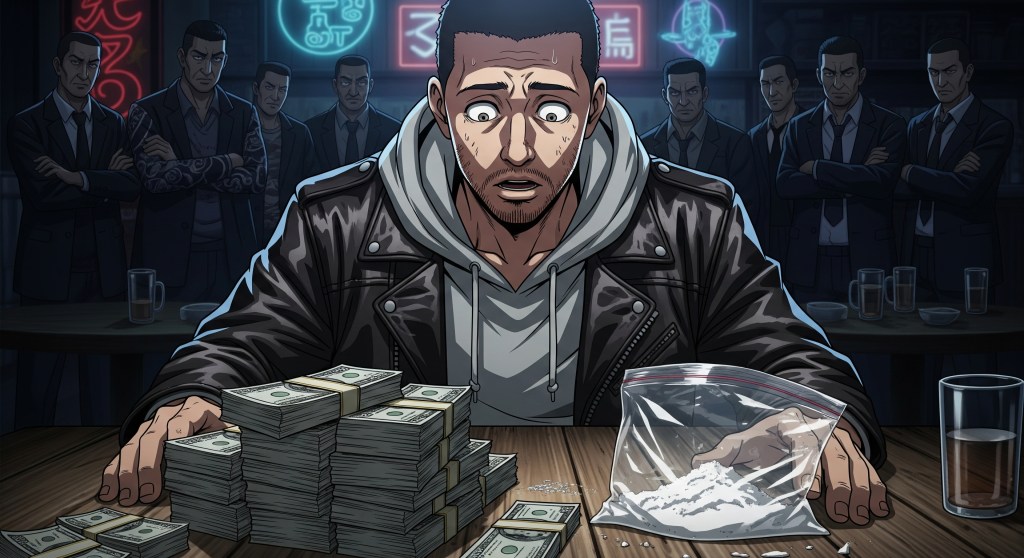
かね と ドラッグ を みつけた。
Kane to doraggu o mitsuketa.
I found the money and drugs.
It’s like a link-up, a way to connect two things together, you feel me? This ain’t no complex grammar, it’s just a way of saying “and,” but only when you’re talking about things, not actions. It’s a straight-up, no-nonsense connector.
The nuance of ~と (~to) is that it’s a list that’s complete. It’s like you’re tellin’ your crew, “Yo, I need a gun and a getaway car.” You ain’t askin’ for nothin’ else. The list is locked and loaded. So if you’re talking about the things you got or the people you’re with, and that’s it, then ~と (~to) is your homie.
This ain’t no verb conjugation, fam. It’s just a straight-up word you stick between the two nouns you wanna connect. Simple and clean.
| English | Hiragana |
| and | と |
Basically, you just put the ~と (~to) right after the first noun. It’s like a handshake between two words, lettin’ everyone know they’re linked. You don’t gotta change nothin’ else. Just Noun 1 と Noun 2. It’s like putting your right-hand man and your main squeeze together, no extra drama.
Think of ~と (~to) like a package deal. When you got a package deal, you get this thing and that thing, all bundled up together. You buy a car, and it comes with the custom rims. You get the whole crew, and that includes your main man and your lookout. It’s a set list, a done deal. It ain’t an open invitation for more stuff. It’s what it is.
You wanna know the real deal on these Japanese words? Step right into my office.
しゅうげきする (Shuugeki suru)
English: To raid; to attack.
Yo, this is when you and your crew roll up on the enemy’s spot, no warning. It ain’t just a regular fight; this is a surprise move, a full-on ambush to catch ’em slippin’. Think of that scene in Heat when De Niro’s crew hits that bank. That’s a textbook raid. You hit fast, hit hard, and get out before the cops know what’s up. It’s about gettin’ the jump on the other side.
どろぼう (Dorobou)
English: Thief.
This right here is the OG. The cat who sneaks in when nobody’s lookin’ and snatches your stuff. He ain’t confrontational; he’s slick. He gets in, grabs the bag, and ghosts before you even know somethin’s gone missing. He’s the type that picks pockets on the subway or breaks into houses when you’re on vacation. He’s all about bein’ sneaky and low-key.
ごうとう を する (Goutou o suru)
English: To rob.
Now, this is a whole different beast. A robber is a straight-up threat. He ain’t hidin’. He looks you dead in the eye, puts a piece in your face, and says, “Gimme your cash.” This is a high-risk game, all about intimidation and force. Think of a stick-up on the street or a holdup at a convenience store. It’s violent, it’s in your face, and it’s all about takin’ what you want by any means necessary.
きょうはく する (Kyouhaku suru)
English: To blackmail; to threaten; to extort.
This ain’t about takin’ money; it’s about takin’ power. You got some dirty secrets on somebody—maybe they been doin’ some shady business or they got a side hustle they don’t want the world to know about. You use that info to get what you want, whether it’s money, favors, or somethin’ else. It’s all about psychological warfare. You ain’t bustin’ down no doors; you’re just pullin’ strings from the shadows, makin’ them sweat until they give in.
だつごくする (Datsugoku suru)
English: To break out of prison.
When the law got you locked down, but you ain’t stayin’. This is for the real escape artists, the ones who ain’t built for a cage. It’s about schemin’ with your cellmates, findin’ a weakness in the system, and makin’ a run for it. Think about the homies from The Shawshank Redemption, tunnelin’ for years, or the cats from Escape from Alcatraz, makin’ a raft out of raincoats. This is the ultimate freedom play, riskin’ everything to be back on the streets.
Check it, these sentences are all about that life.
かれ とボス は けいむしょ から だつごく した。
Kare to bosu wa keimusho kara datsugoku shita.
He and the boss escaped from prison.
ぶき と かね が ここ に ある。
Buki to kane ga koko ni aru.
The weapons and the money are here.
あの おんな と どろぼう は いっしょ に はたらいた。
Ano onna to dorobou wa issho ni hataraita.
That woman and the thief worked together.
おれ と ボス は ぎんこういん を きょうはく した。
Ore to bosu wa ginkouin o kyouhaku shita.
The boss and I threatened the bank employee.
おれ と あに は ごうとう を した。
Ore to ani wa goutou o shita.
My brother and I committed a robbery.
この けんじゅう と くるま を ぬすんだ。
Kono kenjuu to kuruma o nusunda.
I stole this handgun and car.
どろぼう と けいさつ が けんか した。
Dorobou to keisatsu ga kenka shita.
The thief and the police officer fought.
おれ と あに は けいむしょ に いた。
Ore to ani wa keimusho ni ita.
My older brother and I were in prison.
じゅう と ナイフ を かくした。
Juu to naifu o kakushita.
I hid the gun and the knife.
ぎんこう と ほうせきてん を しゅうげき した。
Ginkou to housekiten o shuugeki shita.
I raided the bank and the jewelry store.
Peace out. Stay G.

Leave a comment