

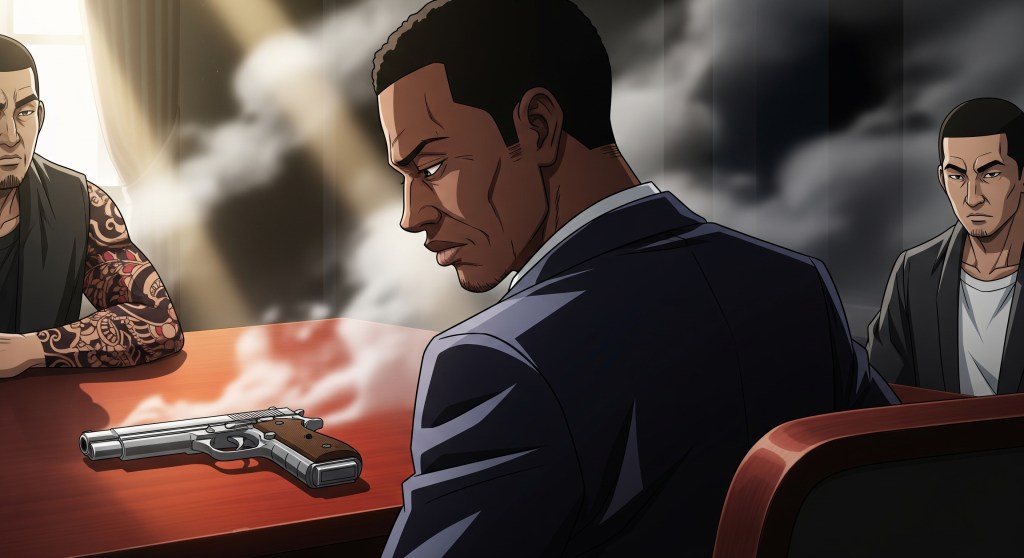
昔のようにもう拳銃は持つまいと決めたんだ。
むかし の ように もう けんじゅう は もつまい と きめたんだ。
I decided I ain’t gonna carry a piece anymore like I used to.
This joint right here is all about tellin’ someone, or yourself, “I ain’t gonna do that,” or “That probably ain’t gon’ happen.” It’s got that strong, no-nonsense vibe, like a boss makin’ a call. It’s not just a soft “no.” It’s a hard “nah.” You feel me? It’s like when you tell your crew, “We ain’t gon’ get caught slippin’,” or when you look at a snitch and say, “He ain’t never gon’ talk.” It’s got that serious, defiant energy to it.
But hold up, let’s not get it twisted. Vるまい ain’t a one-trick pony. This grammar pattern also got another side to it. It can also mean “probably not,” or “I reckon that won’t happen.” This is more like a prediction from a G, not a vow. It’s an old-school way of speakin’ and you’ll mostly see it when you’re readin’ some serious stuff, not when you’re just chillin’ with your crew. Since it’s a guess, you can talk about what some other cat is probably not gonna do. You can use it to talk about a third person, not just yourself. I’ve seen this in lots of old school anime like Bleach, especially with the older characters.
Peep the formula for how to hook this up.
| Verb Group | Dictionary Form (Vる) | ~まい Form | English Translation |
| Group 1 (Godan) | 書く かく | 書くまい | Ain’t gonna write |
| 飲む のむ | 飲むまい | Ain’t gonna drink | |
| 会う あう | 会うまい | Ain’t gonna meet | |
| Group 2 (Ichidan) | 食べる たべる | 食べまい / 食べるまい | Ain’t gonna eat |
| 見る みる | 見まい / 見るまい | Ain’t gonna see | |
| 信じる しんじる | 信じまい / 信じるまい | Ain’t gonna believe | |
| Group 3 (Irregular) | する | しまい / するまい / すまい | Ain’t gonna do |
| 来る くる | 来まい くまい | Ain’t gonna come |
So here’s the lowdown on the conjugation. For your Group 1 verbs, the ones that end in that “-u” sound, you just slap まい right on the end of the dictionary form. Easy money. For Group 2 verbs, the “-iru” and “-eru” cats, you got options. You can either drop the final る and add まい, or you can just add まい to the dictionary form. Both are straight. Now, for the irregulars, the real OGs: する can roll as するまい, すまい, or しまい. They all mean the same thing, just different flavors. And for 来る, it turns into 来まい (くまい). Don’t mess that up, or you’ll sound like a herb.
Think of it like this: Vるまい is like drawin’ a line in the concrete. On one side, there’s the good life, the hustle, the respect. On the other side is the jail cell, the police, and all that lame stuff. When you use Vるまい, you’re standin’ on your side of the line and sayin’ with your whole chest, “I ain’t crossin’ that line.” It’s a vow, a promise to yourself and the streets. The other side of it, the “probably not” meaning, is like lookin’ at another crew from your side of the line and sayin’, “They ain’t gon’ be a problem, I can tell.”
Let’s break down some real talk.
漏らす (もらす)
English: To leak; to spill; to let out.
Aight, listen up. “Morasu” is all about spillin’ the beans, lettin’ secrets slide. You got some classified info, some top-level intel, but you run your mouth and let it slip? That’s you doin’ the “morasu.” It’s like when one of your crew starts singin’ to the cops, droppin’ dimes on the whole operation. Or when you accidentally tell your girl about the surprise party you was throwin’ for her. You ain’t supposed to say nothin’, but the words just come out. Keep your lips sealed, you dig? Loose lips sink ships, and real G’s move in silence.
脅し (おどし)
English: A threat; intimidation.
“Odoshi,” now that’s some gangster business right there. This ain’t about askin’ nicely. This is when you put the pressure on someone, let ’em know what’s gonna happen if they don’t fall in line. It’s that look, that tone of voice, that “suggestion” that ain’t really a suggestion. Think about a shakedown, a little “persuasion” to make sure you get what you want. It’s the muscle in the operation, the stuff that makes people think twice before they cross you. You ain’t gotta throw a punch if your “odoshi” game is strong enough.
屈する (くっする)
English: To yield; to submit; to give in.
Check it, “kussuru” is when you fold. You in a standoff, a turf war, a battle of wills, and you the one who backs down? You just did the “kussuru.” It’s when the pressure gets too real, the heat is too much, and you decide to tap out. No one wants to be the one to surrender, to give up the fight. It’s about losin’ your ground, lettin’ the other side take the W. A real one stands tall, but sometimes, you get cornered, and you ain’t got no choice but to bow down.
顔に泥を塗る (かお に どろ を ぬる)
English: To bring shame upon someone; to drag someone’s name through the mud.
This one’s deep. “Kao ni doro o nuru” is straight-up disrespect. It means you did somethin’ so foul, so outta pocket, that you ain’t just embarrassin’ yourself, you’re bringin’ shame to your whole crew, your family, your name. It’s like puttin’ dirt on their reputation. Your pops builds up a legacy on the streets, and you go and get caught on some rookie-level mistake? You just smeared mud all over his face. It’s about loyalty and honor. You mess up, and that filth splashes on everyone connected to you.
足を踏み入れる (あし を ふみいれる)
English: To set foot in; to step into.
“Ashi o fumiireru” is about crossin’ a line, steppin’ into a new territory, literally and figuratively. It could be you walkin’ onto a rival crew’s block – you best be ready for what comes next. But it’s also about gettin’ into a new game, a new hustle. Once you step in, you’re in. There ain’t no half-steppin’. You’re part of that world now, and you gotta play by its rules. So before you put your foot down, you better be damn sure you know what you’re gettin’ into.
Alright, listen up. Here are 10 examples to show you how to use this grammar right, no games. Pay attention.
俺は決して仲間を裏切るまい。
おれはけっしてなかまをうらぎるまい。
I will never betray my crew.
この情報は誰にも漏らすまい。
このじょうほうはだれにももらすまい。
I will not leak this information to anyone.
借りは必ず返す。この恩は忘れるまい。
かりはかならずかえす。このおんはわすれるまい。
I will definitely pay back my debt. I will not forget this favor.
どんな脅しにも屈するまい。
どんなおどしにもくっするまい。
I will not give in to any threats.
今日の失敗を無駄にするまい。
きょうのしっぱいをむだにするまい。
I will not let today’s failure be in vain.
こっそりと裏切ったあいつを、俺は決して許すまい。
こっそりとうらぎったあいつを、おれはけっしてゆるすまい。
I will never forgive that guy who secretly betrayed us.
俺の顔に泥を塗るような真似はすまい。
おれのかおにどろをぬるようなまねはすまい。
I will not do anything that would bring shame to my name.
奴らはもうここへは来るまい。
やつらはもうここへはくるまい。
They probably won’t come here anymore.
あいつは二度と俺たちのシマに足を踏み入れるまい。
あいつはにどとわれらのしまにあしをふみいれるまい。
That guy will probably never set foot in our territory again.
俺の組織は、この街で負けることはあるまい。
おれのそしきは、このまちでまけることはあるまい。
My organization will probably not lose in this city.
Word up. Stay solid, stay loyal. Keep that mind sharp and that grammar on point. Don’t be a scrub. Peace out.

Leave a comment