

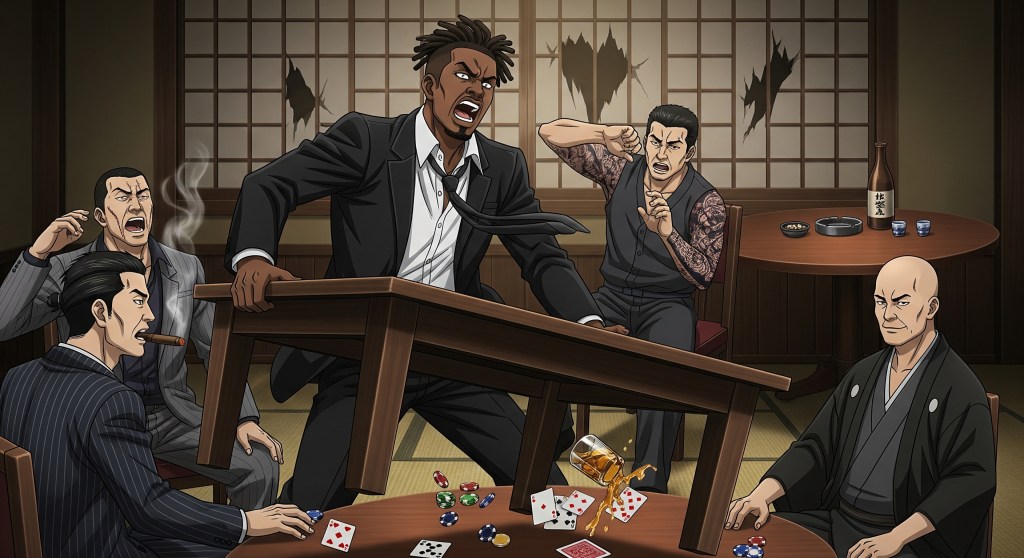
あまりの怒
りで、彼
はテーブルをひっくり返
した。
He was so angry that he flipped the table over.

This grammar pattern is like when somethin’ is so crazy intense—whether it’s a feeling, a state of mind, or a situation—that it leads to some wild result. It’s for those moments when you’re caught up in the drama and can’t help but act a certain way. It’s not just “I was happy, so I smiled.” Nah, it’s more like “I was so damn happy that I couldn’t stop hollerin’ at the homies.” It emphasizes the extreme intensity of the cause, makin’ the result feel outta your control, you feel me?
This is the real G-code for gettin’ this grammar right. Peep the table to see how we link it up.
| Word Type | English Translation | Hiragana |
| あまりの [Noun] に/で | Because of such a [noun] | あまりの [Noun] に/で |
| あまりの [Adjective] さに | Because of how [adjective] it was | あまりの [Adjective] さ に |
| あまりの [Verb] に | Because of so much [verb]ing | あまりの [Verb] に |
Now, let’s get into the nitty-gritty. This grammar pattern is like a two-piece suit. The first piece, あまりの, always stays the same. The second part, the 〜に/で part, is what tells you what’s up. When you’re connectin’ it to a noun, you just slap it right on there. Easy money. But if you’re gettin’ down with an adjective, you gotta show some respect and turn it into a noun by addin’ 〜さ. It’s like you’re makin’ the quality of somethin’ a physical thing you can hold. So, a ‘cold day’ ain’t just cold, it’s the coldness itself that’s doin’ the damage. Get it?
Now, you wanna know the difference between the two? It’s subtle, but it’s important if you want to sound legit.
- あまりの…に (amari no… ni) is like a hard-hittin’ punch. It’s usually used with a negative or unexpected result. It’s for when the situation is so out of control that it leads to something messed up. It’s got that “due to the extreme…” feel.
- あまりの…で (amari no… de) is a little more flexible. It’s also for intense situations, but the result can be a little less dire. It can feel a bit more like a direct, causal link, a “because of the overwhelming…” vibe. You might hear it in a wider range of contexts, but they both get the point across that a regular cause-and-effect just ain’t strong enough.
Think of this grammar like a high-stakes deal on the streets. You got a situation so intense, so outta pocket, that it forces a reaction. It’s like…
You’re a hustler on the block, and the police show up. The あまりの [danger] に (the intensity of the danger) is so real that you instinctively toss your stash and split. The danger is the cause, and your reaction—tossin’ the goods and runnin’—is the inevitable result. You didn’t plan it; the pressure of the moment made you do it. That’s the vibe. The situation is so heavy it makes you do something.
Peep this new lingo you about to learn.
執念 (しゅうねん)
English: Tenacity; relentless spirit; obsession.
This ain’t just bein’ stubborn. This is that deep fire inside you, that real grit. It’s when you got a goal and you won’t let go, no matter what. You think about how them hustlers in the game, they got that 執念 to make it to the top. They see the paper, they see the power, and they ain’t stoppin’ ’til they get it. It’s that drive that makes you a legend.
威圧感 (いあつかん)
English: Intimidating presence; an overwhelming air.
This is that feelin’ you get when someone walks in the room and the whole vibe changes. It’s not about them bein’ loud or big—it’s that they got that 威圧感. They stand tall, they move with a purpose, and they got that look in their eyes that says, “Don’t even try it.” Think about a mob boss. They don’t gotta say a word, their presence tells you everything you need to know.
非道さ (ひどうさ)
English: Inhumanity; cruelty; wickedness.
This is talkin’ about some savage-level stuff. It’s when someone does somethin’ so cold, so messed up, it makes you question if they even human. You see it in them crime flicks, when the bad guy pulls some 非道さ and just don’t care about who gets hurt. It’s not just bein’ mean; it’s bein’ straight-up wicked, without a shred of feelin’s.
決意する (けついする)
English: To decide firmly; to resolve.
This ain’t just makin’ a choice. This is lockin’ in, makin’ a promise to yourself that you goin’ all the way. You 決意する to make your mark, to get that cash, to take over the territory. It’s that moment where you burn the boats, know what I’m sayin’? There’s no goin’ back. Once you 決意する, it’s ride or die.
怒り (いかり)
English: Anger; rage; fury.
This is that fire that burns deep in your chest. It’s more than bein’ mad—it’s that 怒り that can make or break you. It’s what drives a cat to seek revenge or stand up for what’s theirs. It can be a dangerous thing if you let it control you, but sometimes, that 怒り is the fuel you need to fight for your respect and get what’s rightfully yours.
Alright, listen up. Here are 10 examples of how we use this grammar. Take notes and use ’em wisely.
警官
のあまりの威圧感
に、俺
は何
も喋
れなかった。
I couldn’t say a damn thing because of the overwhelming intimidation from the cop.
敵
のあまりの多
さに、俺
たちはすぐに降参
した。
Because there were so many enemies, we surrendered right away.
組織
のあまりの非道
さに、彼
は裏切
りを決意
した
He decided to betray the organization because of their extreme cruelty.
ボスのあまりの怒
りに、誰
も口
を開
けなかった。
No one could open their mouth because of extreme rage of the boss.
仲間
のあまりの強
さに、誰
も彼
を止
められなかった。
My comrade was so strong that noone could stop him
新入
りのあまりの馬鹿
さ加減
に、兄貴
は頭
を抱
えた。
Big bro held his head in his hands because of the rookie’s sheer stupidity.
敵
のあまりの執念
に、ついに俺
たちは捕
まってしまった。
We finally got caught because of the enemy’s incredible persistence.
計画
のあまりの複雑
さに、誰
も完璧
に理解
できなかった。
No one could fully understand the plan because of its extreme complexity.
刑務所
のあまりの劣悪
さに、多
くの囚人
が発狂
した。
Many inmates went crazy because of the extreme squalor of the prison.
ターゲットあまりの警戒心
で、なかなか近
づけなかった。
We couldn’t get close to the target because of his excessive caution.
Keep it real, stay sharp. Peace out.

Leave a comment