

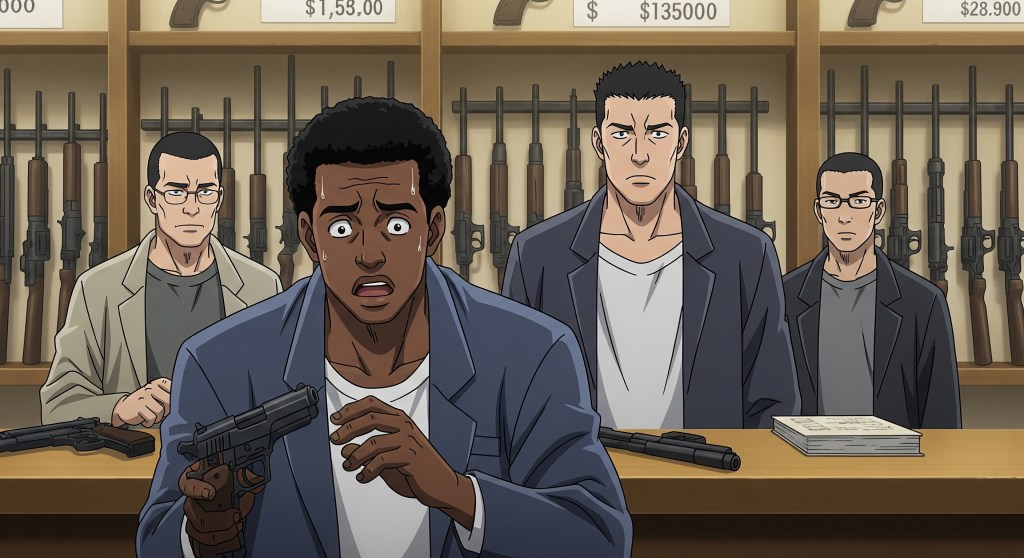
この けんじゅう は たかい です。
kono kenjuu wa takai desu.
This handgun is expensive.
We got two crews on the street: the い-adjectives and the な-adjectives. They both describe things, but they roll different.
So what’s the difference? It’s all about how they connect, ya dig?
い-adjectives are like the solo artists, the Nas or the Biggie Smalls of the grammar world. They’re independent. They got that ‘い’ at the end, and that’s all they need to do their thing. They can stand alone or hook up to a noun with no help. They’re self-made, straight up.
な-adjectives are more like a posse, think Wu-Tang Clan. They need their crew to back ’em up. They can’t just roll up on a noun by themselves; they need their connector, their ‘boy’ な, to make the introduction. When they’re at the end of the line, they need a tough guy like だ (da) or です (desu) to finish the job. They don’t end in ‘い’ (with a few tricky exceptions, but fuhgeddaboudit for now). They need backup, always.
Here’s the lowdown on how these adjectives do their thing, broken down for you so you can see the difference clear as day.
| Type | Adjective Alone | English | Adjective Modifying a Noun | English |
|---|---|---|---|---|
| い-adjective | 寒い (samui) | is cold | 寒い 日 (samui hi) | a cold day |
| 怖い (kowai) | is scary | 怖い 奴 (kowai yatsu) | a scary guy | |
| な-adjective | 賑やかです (nigiyaka desu) | is lively | 賑やかな 店 (nigiyaka na mise) | a lively shop |
| 危険です (kiken desu) | is dangerous | 危険な 場所 (kiken na basho) | a dangerous place |
The real deal is how they hook up with a noun. For the い-adjectives, it’s simple. You just slap that sucker right in front of the noun and you’re good. They don’t need no special handshake. They just fit, smooth as a getaway driver on a Friday night. For the な-adjectives, though, they need that な in the middle. It’s the secret password, the key to the joint. Without it, the whole thing falls apart like a cheap alibi. The “desu” (です) part is for when the adjective is standin’ on its own, makin’ a statement.
Think of it like this: you got two families runnin’ this town.
The I-Family (い-adjectives) are the old-school bosses. Their name always ends in ‘い’, like 大きい (ookii) or 高い (takai). They’re respected. When they wanna describe somethin’, they just show up as they are. “A tall building” is a 高いビル (takai biru). See? The ‘い’ is right there, doin’ all the work. No middleman.
The I-Family’s Top Dogs (い-adjectives)
- 大きい (おおきい) – ookii – big
- 小さい (ちいさい) – chiisai – small
- 高い (たかい) – takai – high, expensive
- 安い (やすい) – yasui – cheap
- 新しい (あたらしい) – atarashii – new
- 古い (ふるい) – furui – old
- いい / よい (よい) – ii / yoi – good
- 悪い (わるい) – warui – bad
- 難しい (むずかしい) – muzukashii – difficult
- 易しい (やさしい) – yasashii – easy
- 面白い (おもしろい) – omoshiroi – interesting, funny
- つまらない (つまらない) – tsumaranai – boring
- おいしい (おいしい) – oishii – delicious
- まずい (まずい) – mazui – bad tasting
- 忙しい (いそがしい) – isogashii – busy
- 楽しい (たのしい) – tanoshii – fun
- 白い (しろい) – shiroi – white
- 黒い (くろい) – kuroi – black
- 赤い (あかい) – akai – red
- 危ない (あぶない) – abunai – dangerous
The Na-Family (な-adjectives) are the new crew. Their names are clean, like 有名 (yuumei) or 親切 (shinsetsu). But they can’t connect to a noun without their main enforcer, な. You wanna say “a famous boss”? You gotta say 有名な親分 (yuumei na oyabun). That ‘な’ is the muscle that links ’em together. Without it, there’s no connection, no deal. It’s the handshake.
The Na-Family’s Crew (な-adjectives)
- きれい (きれい) – kirei – clean, beautiful
- 静か (しずか) – shizuka – quiet
- にぎやか (にぎやか) – nigiyaka – lively, bustling
- 有名 (ゆうめい) – yuumei – famous
- 親切 (しんせつ) – shinsetsu – kind
- 元気 (げんき) – genki – healthy, energetic
- 便利 (べんり) – benri – convenient
- 不便 (ふべん) – fuben – inconvenient
- 好き (すき) – suki – likeable
- 嫌い (きらい) – kirai – dislikeable, hateful
- 上手 (じょうず) – jouzu – skillful, good at
- 下手 (へた) – heta – unskillful, bad at
- 暇 (ひま) – hima – free (not busy)
- 大丈夫 (だいじょうぶ) – daijoubu – okay, alright
- 大事 (だいじ) – daiji – important
- 安全 (あんぜん) – anzen – safe
- 簡単 (かんたん) – kantan – simple, easy
- ハンサム (ハンサム) – hansamu – handsome
- 素敵 (すてき) – suteki – lovely, wonderful
- 大変 (たいへん) – taihen – tough, terrible
Peep this section for all the street slang we gon’ be droppin’ in our sentences.
うわさ (Uwasa)
English: Rumor; hearsay.
What you hearin’ on the streets ain’t always the gospel, you feel me? A rumor is that whisperin’ game, spreadin’ from one block to the next. It might be true, it might be cap. Like, you hear a new connect is in town, or that the cops are sweepin’ the neighborhood. You gotta be smart and know who to trust, ’cause a bad rumor can get you got.
じゅうだん (Juudan)
English: Bullet.
This right here is the truth. A bullet ain’t a joke, fam. It’s that piece of lead that comes flyin’ out the barrel. You see ’em in the movies all the time, but out here on the real, it’s a different story. You hear that sound, and you know it ain’t no play-play. It’s the final word, the end of a long conversation, if you get my drift.
そしき (Soshiki)
English: Organization; syndicate; gang.
This ain’t just a crew of homies hangin’ out. This is a full-blown organization. It’s got structure, rules, a top dog, and everybody’s got a role to play. Think of it like a business, but with a different kind of product. The mob, the Yakuza, a street gang—they’re all an organization. Loyalty is everything, and you mess with the family, you mess with the whole damn thing.
そうこ (Souko)
English: Warehouse.
A warehouse is where the real business goes down behind closed doors. It’s a big, empty spot, usually on the low-key side of town. It’s where you stash the goods, hold a meetin’ with the whole crew, or lay low when the heat is on. It’s got no windows, no noise—perfect for makin’ a deal or hidin’ a whole lot of somethin’.
アジト (Ajito)
English: Hideout; safe house; a secret base.
When you hear “ajito,” you gotta think about a spot that ain’t on the map. This ain’t your grandma’s house, nah. This is where the real business goes down, a secret fortress where the crew stacks their cash, plans the next big score, and lays low when the heat is on. It’s the ultimate hideout, the safe zone where nobody knows your name and the rules don’t apply. It’s where you go to get organized and stay off the grid, feel me? It’s the real trap house, the one you can’t find on no navigation.
Yo, check the steez on these sentences. They’re all about that life, but they got a little twist to them, ya know?
この けんじゅう は おもい です。
Kono kenjuu wa omoi desu.
This gun is heavy.
あそこ の そうこ は ふるい です。
Asoko no souko wa furui desu.
That warehouse over there is old.
その そしき は つよい です。
Sono soshiki wa tsuyoi desu.
That organization is strong.
わたし の なかま は やさしい です。
Watashi no nakama wa yasashii desu.
My homies are kind.
その じゅうだん は ちいさい です。
Sono juudan wa chiisai desu.
That bullet is small.
あたらしい アジト は ひろい です。
Atarashii ajito wa hiroi desu.
The new hideout is spacious.
まち に おもしろい うわさ が あります。
Machi ni omoshiroi uwasa ga arimasu.
There’s an interesting rumor in the city.
この けいさつ は しんせつ ですか。
Kono keisatsu wa shinsetsu desu ka.
Is this police officer kind?
この シノギ は ゆうめい なんだ。
Kono shinogi wa yuumei nanda.
This hustle is famous, you know.
カシラ は きけん な しごと を はじめた。
Kashira wa kiken na shigoto o hajimeta.
The boss started a dangerous job.
Stay up, stay real, and keep hustlin’ with that knowledge. You feel me? Peace out.

Leave a comment