

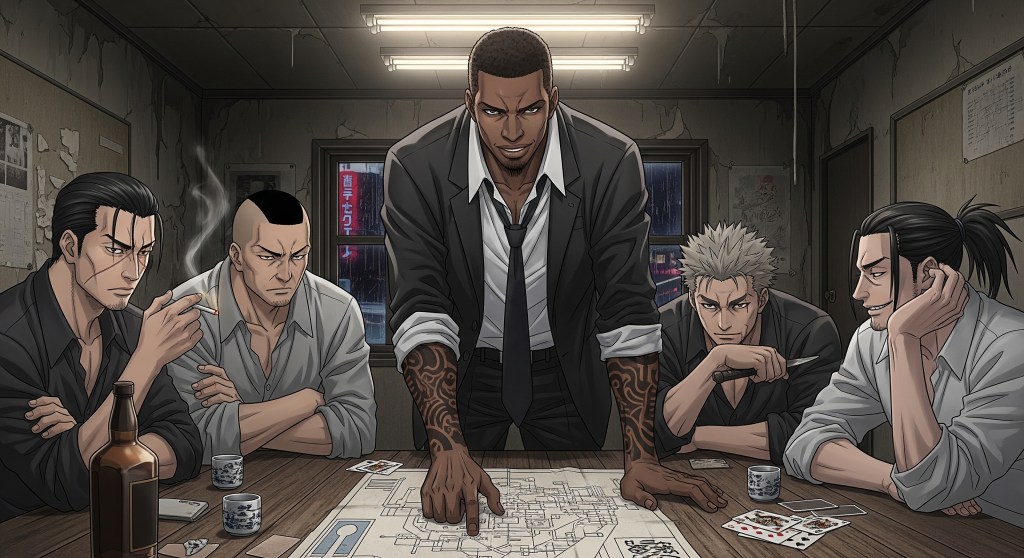
あいつはおれらをうらぎった。だから、ふくしゅうしなければならない
Aitsu wa orera o uragitta. Dakara, fukushuu shinakereba naranai.
He betrayed us so we must get revenge!
It’s a straight-up declaration, a necessity. This grammar point means “must do,” “have to,” or “gotta.” It’s about what ain’t no other way around. It’s for when you can’t just be chillin’. When the big boss tells you to do somethin’, you can’t be like, “Nah, I’m good.” You gotta do it. End of story.
Aight, so here’s how you hook up the verbs. Don’t mess this up, ’cause it’s a one-way ticket to the slammer if you get it wrong.
| Verb Form | Conjugation |
| Negative Plain Form | Replace the final 「い」 with 「ければならない」 |
| Example:いかない Ikanai don’t go | いかなければならない Ikanakereba naranai must go |
| Example: たべない Tabenai don’t eat | たべなければならない Tabenakereba naranai must eat |
This ain’t rocket science, homie. You take a verb, put it in its negative form, drop the final “i” (い), and then slap on ~nakereba naranai (~なければならない). Let’s say you got the verb iku (いく), which means “to go.” The negative form is ikanai (いかない). You drop the “i” and you got ikana. Add the rest and it’s ikanakereba naranai (いかなければならない), which means “you gotta go.” See? Easy money.
Think of it like a street code. When you’re out in the streets, there are certain rules you must follow. You gotta pay respect to the OGs. You have to keep your mouth shut. If you don’t follow these rules, it’s over for you. You don’t have a choice. It’s a life or death thing. なければならない (nakereba naranai) is the verbal equivalent of that street code. It’s non-negotiable.
Aight, listen up. Here’s some new lingo for your vocab list, so you can sound like you’re from the streets, for real.
だまらせる (Damaraseru)
English: To silence; to shut someone up.
Listen up. Sometimes, cats get to talkin’ too much, you feel me? They start flapping their gums about business that ain’t theirs, or they get loud when you need to be quiet. So you gotta shut ’em up. You gotta make ’em go silent. Like in “The Godfather,” when they make an offer someone can’t refuse, and all that chatter just stops. That’s what this word is.
しゃっきん (Shakkin)
English: Debt; loan.
Yo, in this life, you ain’t always flush with cash, right? So you gotta get a loan. That paper you owe someone, that’s your debt. Whether it’s to a bank, or more likely to a powerful dude who ain’t scared to break some fingers to get his money back. That’s your debt. It’s the bread you gotta pay back. You ain’t slick enough to get out of it, either. Just like when Walter White had to work off his debt to Gus Fring in “Breaking Bad.” That’s this word.
したがう (Shitagau)
English: To obey; to follow orders.
Every crew’s got a boss, and the boss makes the rules. When the big man talks, you listen and you do what he says, no questions asked. You obey him. You follow his orders to the letter. This ain’t no democracy. It’s about respect and loyalty. Like when the soldiers in “Boyz n the Hood” followed Doughboy’s lead. You gotta fall in line. That’s this word.
いばしょ (Ibasho)
English: One’s place; whereabouts; a sense of belonging.
Yo, every cat needs a spot where they feel like they belong, a place where they’re not just a number. It’s their place. It’s where you go to feel safe, to be with your own people, to have a purpose. In the streets, your crew gives you that. Your boys are your place. Like the way the Bloods and Crips give people a sense of belonging in a rough neighborhood. That’s what this word means.
じけん (Jiken)
English: Incident; affair; a case.
Stuff goes down every day, but some stuff is bigger than others. A case, an incident, an affair—that’s a serious event, somethin’ that gets a lot of attention. It could be a street fight, a robbery, or a whole investigation. Like the “Bloody Sunday” incident in Ireland. It’s an event that changes things, and everyone’s got an eye on it. That’s what this word is for.
Aight, let’s get into the sentences. These ain’t for the weak. They’re all about the life, the hustle, and the grind.
おやじ に ほうこく しなければならない。
Oyaji ni hōkoku shinakereba naranai.
I must report to the boss.
だれか に はなす まえ に、やつ を だまらせなければならない。
Dareka ni hanasu mae ni, yatsu o damarasenakereba naranai.
Before he can talk to anyone, we must shut him up.
かれ の しゃっきん を かえさなければならない。
Kare no shakkin o kaesanakereba naranai.
You must repay his debt.
けいさつ に つかまる まえ に、ここ を はなれなければならない。
Keisatsu ni tsukamaru mae ni, koko o hanarenakereba naranai.
We must leave here before the police catch us.
つぎ の しごと の ため に、あたらしい じゅう を じゅんび しなければならない。
Tsugi no shigoto no tame ni, atarashii jū o junbi shinakereba naranai.
We must prepare a new gun for the next job.
おれたち は おやじ の めいれい に したがわなければならない。
Oretachi wa oyaji no meirei ni shitagawanakereba naranai.
We must obey the boss’s orders.
てき の いばしょ を みつけなければならない。
Teki no ibasho o mitsukenakereba naranai.
You must find the enemy’s hideout.
おれ は けいむしょ を でた あと、まじめ に はたらかなければならない。
Ore wa keimusho o deta ato, majime ni hatarakanakereba naranai.
After I get out of jail, I gotta work seriously.
きけん な にんむ だから、よく けいかく しなければならない。
Kiken na ninmu dakara, yoku keikaku shinakereba naranai.
Since it’s a dangerous mission, you gotta plan it well.
この じけん を だれ にも はなして は ならない。
Kono jiken o dare nimo hanashite wa naranai.
You must not speak of this incident to anyone.
Ya heard me? That’s the real deal right there. Now go on and handle your business.
Peace out.


Leave a comment