

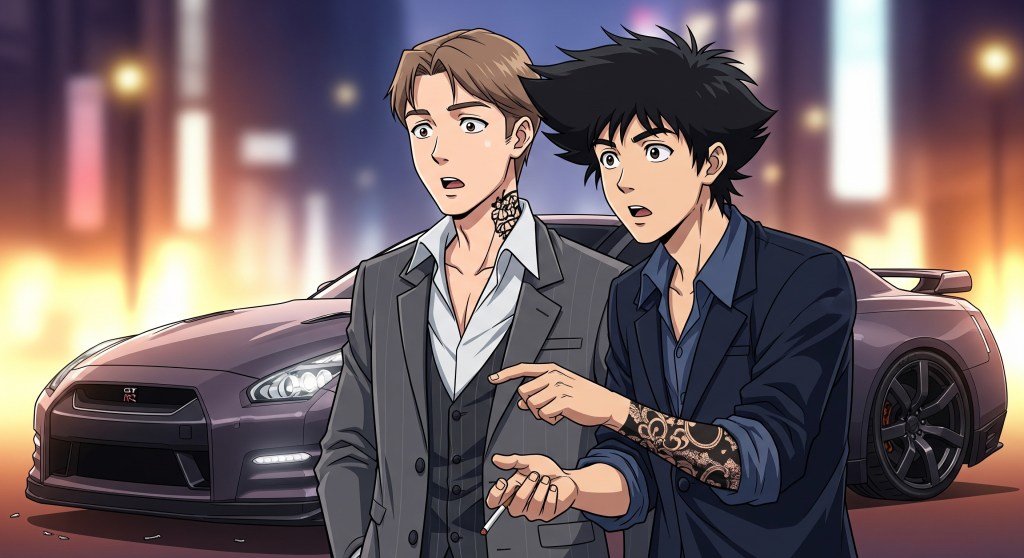
この くるま、 すげー はやい ね。
Kono kuruma, sugee hayai ne.
This car is crazy fast, isn’t it?

In Japanese, ね (ne) is a sentence-ending particle that you slap on when you’re tryna get confirmation from the other person. It’s like you’re saying, “Right? Ain’t that the truth?” or “You know what I’m talkin’ about?” You use it when you’re pretty sure the other person is gonna agree with you. It’s for when you’re vibin’ on the same frequency. If you wanna sound smooth and get people on your side, you gotta master this one.
Using ね (ne) is simple, fam. You just put it at the end of a sentence. It don’t matter what the word is, just drop it at the end and you’re good.
| Part of Speech | Conjugation |
| Verbs | verb + ね (ne) |
| Nouns | noun + だ (da) + ね (ne) |
| い-Adjectives | い-adjective + ね (ne) |
| な-Adjectives | な-adjective + だ (da) + ね (ne) |
Imagine you’re the main man in the crew, and you’re layin’ down the law. You just told your boys what’s up, and now you look ’em in the eye, and you nod. That nod, that’s what ね (ne) is. It ain’t a question, it’s a statement with a built-in “you feel me?” attached to it. It’s for when the whole squad is on the same page. You’re not asking if they agree; you’re just gettin’ that little verbal head nod back to confirm y’all are in this together.
Here’s some slang to get you on the level:
ビビって (Bibitte)
English: To get scared; to be a coward.
When you in the streets, you gotta be ready for anything, nahmean? But sometimes, a cat gets shook. He freezes up, his hands get all clammy. That’s what this word is. You see a dude who acts all tough, but when the heat is on, he starts trippin’? He’s ビビって (bibitte). He’s scared like a little kid when the lights go out. A real G don’t get shook, he stands his ground.
あし を あらう (Ashi o arau)
English: To wash one’s feet; to go straight; to quit the life.
In the game, you either go hard or go home. But for real, a lot of hustlers wanna get out, too. They see the writing on the wall, feel me? This phrase means you lettin’ go of all that illegal stuff and gettin’ on the straight and narrow. Like when a cat decides to leave the crew for good and get a regular job, he’s あし を あらう (ashi o arau). He’s cleanin’ his hands of all the dirt and tryin’ to live right. It’s like Michael Corleone tryin’ to go legit in “The Godfather.”
100まんドル (Hyaku-man doru)
English: One million dollars.
A million bucks, that’s the dream, right? That’s the paper everybody out here chasin’. This phrase is what you say when you talkin’ ’bout that big, big money. A million dollars. That’s enough to get your whole crew straight, buy some real nice whips, and get a big-ass house with a pool. It ain’t just a number, it’s a lifestyle. You see a cat talkin’ bout his “one hundred million dollar” deal? That’s a 100まんドル (hyaku-man doru) deal, fo’ sure.
ゆるされない (Yurusarenai)
English: Unforgivable; cannot be forgiven.
In this life, there are certain things you just can’t come back from. You cross the line, you break the code, you betray your own fam. That’s when you do somethin’ ゆるされない (yurusarenai). It means what you did is so messed up, there ain’t no fixin’ it. No apology, no nothin’ is gonna make it right. Like when Sonny Corleone found out his brother-in-law was messin’ with the rival gang. That was unforgivable.
デカいかおする (Dekai kao suru)
English: To act all high and mighty; to be arrogant.
You know them cats who get a little paper and start walkin’ around like they own the whole block? They look down on everybody, got that chest poked out all day. That’s what this means. They think they’re hot stuff and ain’t nobody on their level. They got a “big face.” It’s not a real big face, ya dig? It’s just their ego gettin’ bigger than they head. You see a dude who’s a know-it-all, always talkin’ down to you? He’s got a デカいかおする (dekai kao suru) attitude.
I got some examples for you. These sentences are gonna show you exactly how we use ね (ne) on the streets.
あの やつ は まじ で ビビって た ね。
Ano yatsu wa maji de bibitte ta ne.
That guy was really scared, wasn’t he?
あたらしい しま を ひろげる のは たいへん だ ね。
Atarashii shima o hirogeru no wa taihen da ne.
Expanding our new territory is tough, right?
あし を あらう なんて、 かんたん じゃない ね。
Ashi o arau nante, kantan ja nai ne.
Quitting the life of crime isn’t easy, is it?
この かね、 ぜんぶ で 100まんドル あった ね。
Kono kane, zenbu de hyakuman-doru atta ne.
There was a million dollars in this money, right?
あの けいさつかん は まじ で しつこい ね。
Ano keisatsukan wa maji de shitsukoi ne.
That cop is seriously persistent, isn’t he?
つぎ の しごと は かなり きけん だ ね。
Tsugi no shigoto wa kanari kiken da ne.
The next job is pretty dangerous, isn’t it?
やつ の うらぎり は ゆるされない こと だ ね。
Yatsu no uragiri wa yurusarenai koto da ne.
His betrayal is unforgivable, isn’t it?
ボス は いつも ただしい こと を いう ね。
Bosu wa itsumo tadashii koto o iu ne.
The boss always says the right thing, doesn’t he?
アイツ、 ケツ を もつ って いった のに にげた ね。
Aitsu, ketsu o motsu tte itta no ni nigeta ne.
That dude said he’d take the fall, but he ran away, didn’t he?
さいきん アイツ、 デカいかお してっ けど、 ちょうし のってる ね。
Saikin aitsu, dekai kao shite kkedo, chōshi notteru ne.
Lately, that guy’s been acting all high and mighty, he’s getting cocky, right?
Now you know how to use ね (ne) to keep everyone on the same page. Go out there and use it to keep the peace. Word up.
Peace out.

Leave a comment