

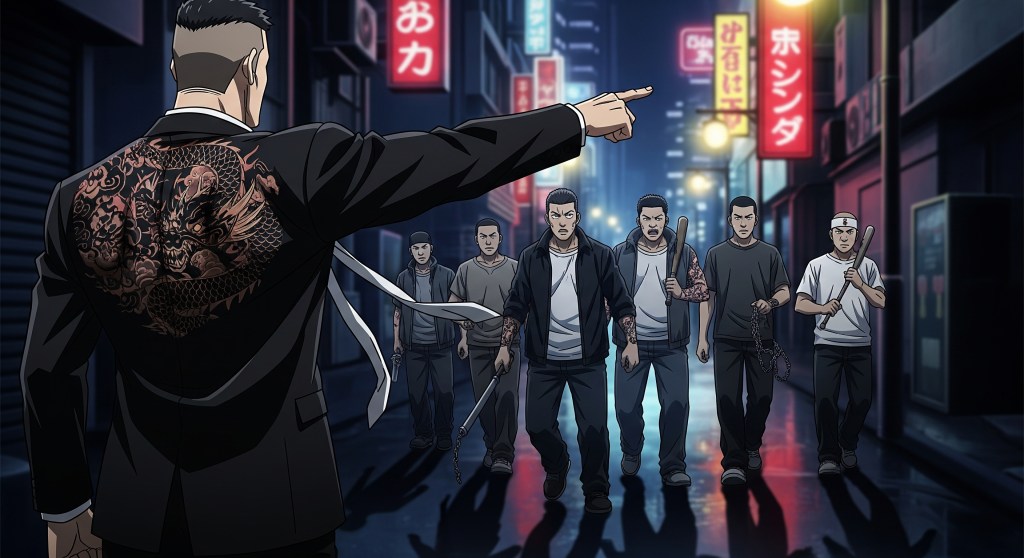
てき は、すぐ そこ だ。
Teki wa, sugu soko da.
The enemy is right there.
だ (da) is the no-nonsense, straight-up way to end a sentence. It’s the equivalent of saying “it is,” “they are,” or “this is what it is,” but with that extra sauce. It’s the casual way of talkin’, like you’re kicking it with your crew. You use it when you’re stating a fact or a strong opinion, but you don’t need to be all proper and respectful like you’re talking to a judge. This is how you tell it like it is.
The vibe is straight-up. Imagine you’re on the block, and someone asks you, “What’s the deal with that cat?” You ain’t gonna say “desu” and be all polite. Nah, you’re gonna hit them with a “He’s a snitch, da.” It’s direct, it’s confident, and it lets everyone know where you stand. You can’t be out here soundin’ weak. This is the grammar for when you gotta lay down the law.
This is how you hook up ‘da’ with different types of words. It’s simple, just watch.
| Word Type | Hiragana | English |
| Nouns | やくぶつ ちゅうどくしゃ だ | It’s a drug addict. |
| い-Adjectives | きけん だ | It’s dangerous. |
| な-Adjectives | かんぺき だ | It’s perfect. |
‘da’ is like your right-hand man. When you’re dealing with nouns and adjectives, you just slap ‘da’ on the end of ’em. But remember, when you use ‘na-adjectives,’ you drop that ‘na‘ before you add ‘da.’ It’s like you’re cutting the fat and getting straight to the point. No need for extra syllables when you’re trying to get your message across quick. Just keep it lean and mean, like a true G.
This ‘da’ thing is just like a verbal stamp you put on your words. Think of it like a brand or a signature. When you’re putting a mark on something, you don’t use a flowery cursive; you use a bold, clear stamp. ‘da’ is that stamp. It’s a declarative statement that says “This is it, no cap.” It’s not a question, it’s not a suggestion; it’s a solid, undeniable fact.
Peep this new words before you run the examples.
やばい (Yabai)
English: Bad; dangerous; awesome; great.
Yo, this one’s wild ’cause it can mean two totally different things, ya dig? It can mean somethin’ is straight-up bad news, like when the cops show up and you gotta bounce. “Oh man, the heat’s here, this is yabai!” But it can also mean somethin’ is dope as hell, like a new pair of Jordans or a beat that’s fire. “Yo, that track is yabai!” It’s all about how you say it, feel me?
ケジメを つける (Kejime o tsukeru)
English: To take responsibility; to put an end to something; to draw a clear line.
This ain’t just about sayin’ “my bad.” This is about settin’ things right. It’s when you mess up, and you gotta do what you gotta do to make it right. It’s about closin’ the book on some drama for good. Like if you cross the wrong crew, you gotta kejime o tsukeru. That might mean you gotta pay up, or maybe you gotta take a beatdown. It’s about respect and gettin’ things straight.
ボロボロ (Boroboro)
English: Tattered; worn-out; ragged.
This is when somethin’ is completely trashed. It ain’t just a little scratch, nah. It’s busted, torn up, and lookin’ like it’s seen better days. Think of an old car after a high-speed chase, all beat up and full of bullet holes. That car is boroboro. Or think of a dude after gettin’ jumped by a whole crew. He’s gonna be lookin’ boroboro.
けんじゅう (Kenjuu)
English: Handgun; pistol.
Straight up, this is what you call a piece, a burner, a strap. It’s a small firearm you can hold in your hand. Like the one Al Pacino’s got in “Heat” when he’s robbin’ banks. You don’t wanna be caught slippin’ without a kenjuu if you’re in the wrong neighborhood.
しゅっぴ (Shuppi)
English: Expenses; expenditure.
This is all the money you gotta spend to keep your operation runnin’. It’s the cash you gotta lay out for new equipment, for bribin’ people, or just for keepin’ your crew fed. If you’re a mob boss, you gotta keep track of your shuppi to make sure the money comin’ in is more than the money goin’ out. It’s all part of the game.
Check it, these sentences are straight from the streets. Peep the examples below, and you’ll be speakin’ like a true OG in no time.
あの やくざは まじで やばい やつ だ。
Ano yakuza wa maji de yabai yatsu da.
That yakuza is a very bad guy.
ケジメを つけるのが、おれたち の ルール だ。
Kejime o tsukeru no ga, oretachi no ruuru da.
Taking responsibility is our rule.
つぎ の かちこみ の リーダー は、おまえ だ。
Tsugi no kachikomi no riidaa wa, omae da.
You’re the leader for the next raid.
おれの ヒットマン は はなさない おとこ だ。
Ore no hittoman wa hanasanai otoko da.
My hitman is a man who doesn’t talk.
あそこ の じむしょ は、もう ボロボロ だ。
Asoko no jimusho wa, mou boroboro da.
That office is falling apart.
この うらぎりは ゆるせない こと だ。
Kono uragiri wa yurusenai koto da.
This betrayal cannot be forgiven.
その けんじゅう は、ほんもの だ。
Sono kenjuu wa, honmono da.
That gun is the real thing.
この もうけ は、みんなで わける だ。
Kono mouke wa, minna de wakeru da.
This profit is a split between everyone.
おれ の しごとは、まち の そうじや だ。
Ore no shigoto wa, machi no soujiya da.
My job is to clean up the city.
こんや の しゅっぴ は、いたい しゅっぴ だ。
Kon’ya no shuppi wa, itai shuppi da.
Tonight’s expense is a painful expense.
Stay dangerous, my friend. Peace out.

Leave a comment