

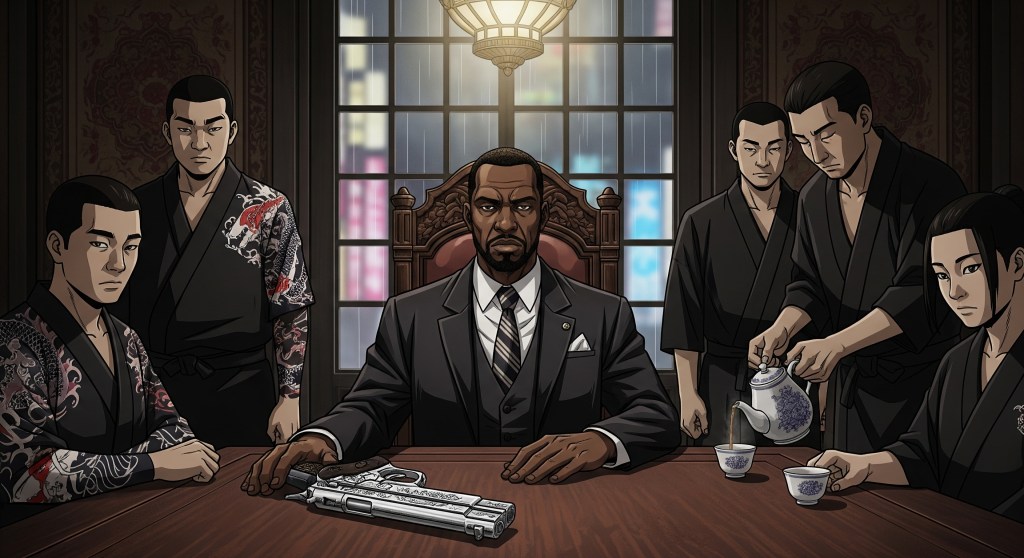
テーブル の うえ に けんじゅう が ある。
Teeburu no ue ni kenjuu ga aru.
There’s a handgun on the table.
We gonna break down something real simple today, but don’t get it twisted, it’s the foundation of this whole language hustle: the verbs ある (aru) and いる (iru).
These two verbs are like the two sides of a coin when you’re talking about something existin’ somewhere. Aru is for the stuff that don’t breathe, you feel me? Like your stack of cash, your ride, or that stash spot. It’s for things that are just there. Iru is for the livin’ things—the homies, the snitches, the cops, your dog. The ones with a heartbeat.
Here’s how you switch these words up, so you’re talkin’ proper.
| Japanese | English |
| ある | To exist (inanimate) |
| あった | Existed (inanimate) |
| ない | Does not exist (inanimate) |
| なかった | Did not exist (inanimate) |
| いる | To exist (animate) |
| いた | Existed (animate) |
| いない | Does not exist (animate) |
| いなかった | Did not exist (animate) |
Listen up. When you talkin’ about what’s goin’ down right now, you use the first two. ある and いる. If you’re talkin’ about somethin’ that already went down, you gotta use the past tense. That’s when you hit ’em with the あった and the いた. Now, if somethin’ ain’t there, you use the negative. ない and いない. And if it wasn’t there back in the day, you go with the negative past tense, なかった and いなかった. It’s all about keepin’ your stories straight.
So listen up. The way to think about this is like you got two different kinds of homies in your crew. You got your ride-or-die homies, the ones who are always with you, always on the move, always doin’ something. That’s いる (iru) for ya. They’re live, they’re movin’, they’re breathin’. Then you got your assets, your bank roll, your crib. That stuff just sits there, doin’ its job, holdin’ it down. That’s ある (aru). It’s a key distinction, so don’t be usin’ いる for your chopper unless that thang is flyin’ on its own.

Peep these words before you run the examples.
ヤサ (yasa)
English: Pad, crib, residence, apartment
Look, every G needs a place to kick back, a spot to call his own. That’s your yasa. It’s your home base, your personal palace, where you hang your hat and count your cash. It’s where you be chillin’ after a long day of gettin’ that paper. You feel me?
チャカ (chaka)
English: Piece, strap, gat, pistol
Straight up, this is what you call your iron, your heater, your chaka. It’s the equalizer, the thing that keeps you safe when things get grimy. It’s that tool that says, “Don’t mess with me.” Every hustler knows you gotta have that chaka on deck, just in case.
ダチ (dachi)
English: Homeboy, homie, friend, pal
A true dachi is your ride-or-die, your ace boon coon. He’s the one who’s got your back no matter what. You’re in the trenches together, holdin’ each other down. You roll deep with your dachi, you break bread with him, and you trust him with your life.
たいきん (taikin)
English: Big money, large sum of money
This ain’t pocket change, fam. This is taikin. We talkin’ stacks, a big payday, a fat bankroll. It’s that paper you get when you pull off a big job, the kind of money that makes moves happen and opens doors. It’s what every hustler is chasin’.
しゃば (shaba)
English: The outside world, civilian life
Shaba is what you call the streets, the world outside of the joint. It’s freedom, man. It’s when you’re no longer locked up, when you can breathe that fresh air and run your business. When you get out of the box, you’re back on shaba, ready to get back to the grind. It’s the world the hustlers operate in.
Peep these sentences so you can use this stuff right, for real.
ボスは ヤサ に いる。
Bosu wa yasa ni iru.
The boss is at the hideout.
マネー は そこ に あった か?
Manee wa soko ni atta ka?
Was the money there?
オヤジ は まだ けいむしょ に いる。
Oyaji wa mada keimusho ni iru.
My old man is still in prison.
きのう、 やつの チャカ は なかった。
Kinou, yatsu no chaka wa nakatta.
Yesterday, his gun wasn’t there.
ダチ は みんな しゃば に でた。
Dachi wa minna shaba ni deta.
All my homies got out of jail.
あの ボス には むすめ が いた。
Ano bosu ni wa musume ga ita.That boss had a daughter.
そうこ に たいきん が あった。
Sōko ni taikin ga atta.
There was a large amount of money in the warehouse.
やつの あじと に ぶき は あった か?
Yatsu no ajito ni buki wa atta ka?
Were there weapons in his hideout?
あの ころ、おれたち には かね が なかった。
Ano koro, oretachi ni wa kane ga nakatta.
Back then, we didn’t have any money.
しゃば に でてきたら だち は いなかった。
Shaba ni detekitara dachi wa inakatta.
When I got out of jail, my homies weren’t there.
この まち には おれ の てき は いない。
Kono machi ni wa ore no teki wa inai.
There are no enemies of mine in this city.
けいさつ は ここ に いた が、もう いない。
Keisatsu wa koko ni ita ga, mou inai.
The police were here, but they aren’t anymore.
Now go on and get that bread, ya heard? Stay dangerous.

Leave a comment