

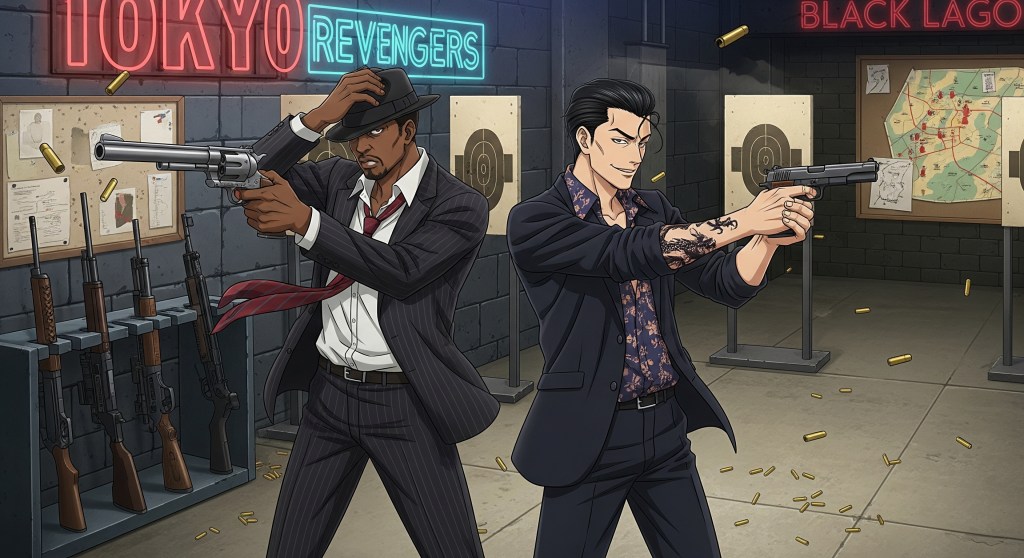
さくや、やつら が ちゃか を うった。
Sakuya, yatsura ga chaka o utta.
Last night, they shot their gats.
Today we’re talkin’ about the -ta form, a real OG in Japanese grammar. It’s how you spit that casual past tense, you feel me? This ain’t for no business meetings. This is for when you’re chillin’ with your crew, reminiscing about the old days, or tellin’ your homie what went down last night. It’s the street-level grammar you need to sound legit.
This form is how you say something went down already. Like, “I ate,” “He went,” “We saw.” It’s straight to the point, no frills. When you use the -ta form, it’s like you’re dropping a beat, a simple, final sound that says, “the action is complete, yo.”
| Verb Type | Conjugation Rule | Casual Past Tense |
| Godan (u-verbs) | Change the ending sound | |
| -ku → -ita | いく iku = いった itta I went | |
| -gu → -ida | およぐ oyogu = およいだ oyoida I swam | |
| -su → -shita | はなす hanasu = はなした hanashita I talked | |
| -tsu → -tta | まつ matsu = まった matta I waited | |
| -ru → -tta | かえる kaeru = かえった kaetta I returned | |
| -mu → -nda | のむ nomu = のんだ nonda I drank | |
| -bu → -nda | あそぶ asobu = あそんだ asonda I played | |
| -nu → -nda | しぬ shinu = しんだ shinda I died | |
| Ichidan (ru-verbs) | Drop the -ru and add -ta | たべる taberu = たべた tabeta I ate |
| Irregular | Got their own rules, you gotta memorize ’em | する = した shita I did |
| くる = 来た kita I came |
Yo, listen up! This ain’t like learnin’ a dance move; you gotta feel the rhythm of this. For the Ru-Verbs, it’s a piece of cake. You just kick that 「る」 to the curb and slide in a 「た」. For the U-Verbs, that’s where you gotta be smart. The sound at the end of the verb tells you what to do. If it’s got that hard sound like 「う」, 「つ」, or 「る」, you gotta give it some juice with a little double 「っ」, and then slap on that 「た」. If it’s all smooth and mellow with 「む」, 「ぶ」, or 「ぬ」, you hit it with that soft 「ん」 sound before the 「だ」. And don’t even get me started on the rest of ’em. Just remember what to do with 「く」, 「ぐ」, and 「す」, and you’ll be straight. And those irregular cats? You just gotta know ’em. They’re the real bosses, so you can’t disrespect ’em. Learn ’em or get left behind.
Think of the -ta form like gettin’ a tattoo. When you get a tattoo, it’s done. It’s permanent. It’s a sign that something happened and it ain’t changin’. You don’t get half a tattoo and say it’s complete. Nah, you get the whole thing. The -ta form is the same thing, yo. The action is done, finished, a permanent mark in time.
Check out these words before you hit the example sentences.
いっぱい くわせる (Ippai kuwaseru)
English: To deceive; to trick someone; to make someone fall for a lie.
This is when you run a game on somebody, you know? You hit ’em with a whole bunch of lies and make ’em think they’re gettin’ one thing, but you really settin’ ’em up for somethin’ else. You’re playin’ ’em. Like when a dude tells a chick he’s a big-time music producer and he’s gonna make her a star, but he’s just a regular cat with no connections. He’s feedin’ her a bunch of nonsense. He’s Ippai kuwaseru.
パクる (Pakuru)
English: To steal; to rip off; to jack.
This is a word for snatchin’ somethin’ that ain’t yours. You see some fresh kicks, some fancy jewelry, or a fancy whip, and you just take it. It’s not yours, but you got it now. It’s like what happens in those heist movies like “Ocean’s Eleven.” They go in and paku the whole casino’s money.
サボる (Saboru)
English: To skip out on work or school; to slack off.
When you’re supposed to be somewhere, but you decide to bail, that’s this word. You’re sittin’ at home playin’ video games or chillin’ with your crew instead of goin’ to your job or to class. You’re saboru. It’s like when Ferris Bueller played hooky from school. He was saboru.
ドス (Dosu)
English: A dagger; a knife.
This is a short, thick blade. It ain’t a kitchen knife, ya dig? This is the kinda blade you see a gangster packin’ in a movie, tucked away so nobody sees it. It’s for protection, you feel me? Like what they be callin’ a shank or a switchblade in the streets. That’s a dosu.
ブッチする (Bucchi suru)
English: To bail; to ditch someone; to ghost.
This is when you leave somebody hangin’. You make plans to meet up, but you never show, and you don’t even hit ’em up to let ’em know you ain’t comin’. You just buchi suru. It’s the ultimate no-show. It’s like when you’re supposed to meet your connect, but you just never pull up. You’re ghost. You buchi suru.
Yo, check the examples, fam. This is how you really use it.
おれ は あいつ に いっぱい くわせた。
Ore wa aitsu ni ippai kuwaseta.
I played him for a fool.
あの くみ は さいきん しのぎ を かえた らしい。
Ano kumi wa saikin shinogi o kaeta rashii.
I heard that gang recently changed their hustle.
おれたち は てき の じょうほう を パクった。
Oretachi wa teki no jouhou o pakutta.
We snatched the enemy’s information.
あいつ は ボス に たてついた から シメられた。
Aitsu wa bosu ni tatetsuita kara shimerareta.
He talked back to the boss so he got roughed up.
あいつ は きのう、みはり を サボった。
Aitsu wa kinou, miharita o sabotta.
He skipped his lookout duty yesterday.
この じゅう は どこ で て に いれた ん だ?
Kono juu wa doko de te ni ireta n da?
Where did you get this gat?
かれ は なかま を うらぎって にげた。
Kare wa nakama o uragitte nigeta.
He betrayed the crew and ran away.
ヤツがドスをぬいた から おれ も かまえた。
Yatsu ga dosu o nuita kara ore mo kamaeta.
He pulled out his blade, so I got ready.
かれら は とりひき を ブッチした。
Karera wa torihiki o bucchishita.
They flaked on the deal.
おれ は むかし、まち の ボス だった。
Ore wa mukashi, machi no bosu datta.
I used to be the boss of the block.
Stay dangerous, fam. Peace.

Leave a comment