

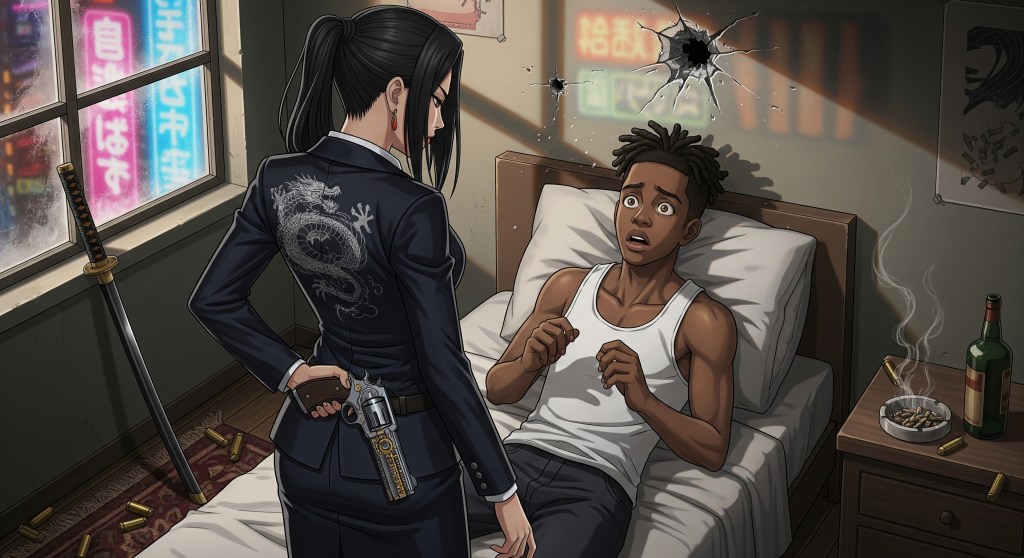
きのうの よるの じゅうせいは、ただの まぼろしじゃなかった。
kinou no yoru no jūsei wa, tada no maboroshi ja nakatta.
The gunshot last night wasn’t just a hallucination.
This ain’t no simple grammar point. This is the kinda thing you use when you gotta correct the record, you know? Like, when you thought somethin’ was one way, but then you find out it was somethin’ else entirely. It’s like a plot twist in a movie, but you’re the one deliverin’ the news.
It’s the past negative form of ~だ (da), which is like the “is” or “are” of the Japanese language. So, when you add じゃなかった to a noun or a な-adjective, you’re basically sayin’ “it was not” or “that wasn’t the case.”

Listen, this ain’t complicated. We just be connectin’ the dots. Here’s how you put that ~じゃなかった on different words.
| Word Type | Conjugation | English | Hiragana |
| Noun | noun + じゃなかった | It wasn’t… | ~じゃなかった |
| な-adjective | な-adjective + じゃなかった | It wasn’t… | ~じゃなかった |
Nah, we ain’t messin’ with no other types of words for this. Just nouns and な-adjectives. You just take the word, drop the だ or な, and slap じゃなかった on the end. Simple. Don’t be makin’ this harder than it is. It’s like puttin’ a magazine in a clip—you just gotta know where it goes.
Think of it like this: You thought you were in the clear, but then the cops roll up and say, “It wasn’t your car we were lookin’ for.” Or you’re with the crew, and you say, “Yo, that wasn’t the right house we hit up last night.” It’s for when you’re makin’ a correction to the game. You’re sayin’, “Nah, that ain’t it. The real deal was somethin’ different.”

Peep these words to better understand the streets.
はこびや (Hakobiya)
English: Smuggler; transporter.
Yo, you need to move somethin’ from point A to point B, somethin’ heavy that can’t be seen? You call a hakobiya. They’re the ones who handle the transportation, the delivery, the whole operation without leavin’ a paper trail. They’re like the mule in “The Mule,” or the driver from “Drive”—they get the package where it needs to go, no questions asked.
しめる (Shimeru)
English: To beat someone up; to rough someone up.
Yeah, you heard right. When you shimeru somebody, you ain’t just talkin’ to ’em—you’re puttin’ hands on ’em. It’s when you gotta send a message with your fists, to let ’em know who’s boss. It’s that classic “Godfather” move where you get a little rough with someone who ain’t playin’ by the rules. It’s a reminder that actions have consequences in the streets.
くみいん (Kumiin)
English: Gang member; mobster.
Every crew, every syndicate, every mob family has its members. They’re the kumiin. They’re the soldiers, the foot soldiers, the ones who follow orders and hold it down for the family. They’re like the guys in “Goodfellas” or the soldiers in “The Godfather”—loyal to the end, livin’ by the code.
なわばり (Nawabari)
English: Territory; turf.
This is where you eat, sleep, and do your business. Your nawabari is your turf, your hood. It’s the block you run, the neighborhood you protect. You gotta respect another crew’s turf, and you gotta be ready to defend yours, ’cause ain’t nobody gonna let you set up shop on their block without a fight. Think of the territories in “West Side Story” or the drug corners in “The Wire.”
わな (Wana)
English: Trap.
The streets are a jungle, and you gotta be smart, you gotta be slick. A wana is a trap—a setup. It’s when someone sets you up, baits you into a situation where you get caught slippin’. The cops set a trap, a rival crew sets a trap. It’s that moment in “Pulp Fiction” where they walk into a situation that ain’t what it seems.
Check out these examples so you know how to use this joint right.
きのうの とりひきは わなじゃなかった。
kinō no torihiki wa wanaja nakatta.
The deal yesterday wasn’t a trap.
この なわばりは やくざの けつを もって いなかった。
kono nawabari wa yakuza no ketsu o motte inakatta.
This turf wasn’t backed by the yakuza.
やつを しめる ひつようじゃなかったんだ。
yatsu o shimeru hitsuyō ja nakattanda.
It wasn’t necessary to beat him up.
かのじょは くみちょうじゃなかった。ただの はこびやだった。
kanojo wa kumichōja nakatta. tada no hakobiya datta.
She wasn’t the boss. She was just a courier.
この けいかくは、あいつらには かんたんじゃなかった。
kono keikaku wa, aitsura niwa kantanja nakatta.
This plan wasn’t easy for them.
その かねは きたない かねじゃなかった。
sono kane wa kitanai kaneja nakatta.
That money wasn’t dirty money.
あそこは うちの なわばりじゃなかったんだ。
asoko wa uchi no nawabari ja nakattanda.
That wasn’t our territory.
おれを うらぎった やつは、まさか おまえじゃなかったか。
ore o uragitta yatsu wa, masaka omaeja nakattaka.
The guy who betrayed me, it wasn’t you, was it?
あの おとこの めは、ほんものの くみいんじゃなかった。
ano otoko no me wa, honmono no kumiin ja nakatta.
That man’s eyes weren’t those of a real gang member.
あの ときの はなしは、ただの じょうだんじゃなかった。
ano toki no hanashi wa, tada no joudanja nakatta.
The conversation back then wasn’t just a joke.
Stay low and stay legit. Peace.

Leave a comment