

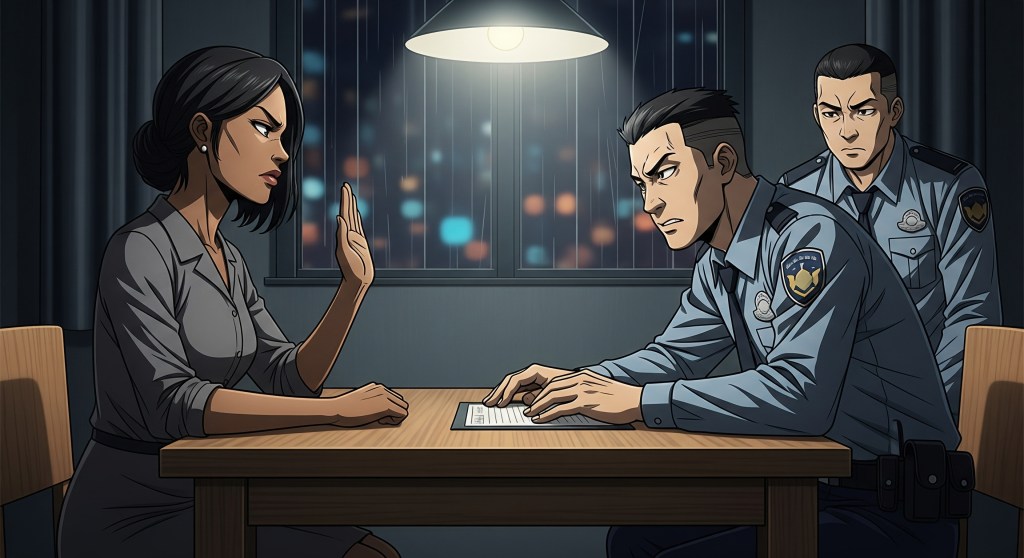
かのじょ は わたしたち に ひみつ を はなし ませんでした。
Kanojo wa watashitachi ni himitsu o hanashi masen deshita.
She didn’t tell us the secret.

Read the explanation below to understand the nuance of how this grammar structure is used.
So, check it. ませんでした (masendeshita) is the heavy-duty way to talk about the past. It’s how you let everyone know that something didn’t go down. Think of it like the “negative past tense.” You use this when you’re tryna say, “I didn’t do this,” or “that didn’t happen.” It’s straight to the point, no fluff.
The nuance is all about being formal and definitive. It’s the kind of language you’d use when you’re reportin’ back to the boss. You ain’t messin’ around with no “nah, I ain’t” stuff. You’re sayin’, “It didn’t happen, Capo.”
The Metaphor: The Security Tape Erase

Imagine your life is a security camera tape.
- Masu (ます): The camera is recording right now.
- Mashita (ました): The footage is saved in the archive.
- Masen Deshita (ませんでした): You went back into the security room, found that specific file from yesterday, and deleted it.
When you say ませんでした, you are telling the listener: “Check the tapes, homie. That action? It does not exist in the history books.”

Read the table below then use it to conjugate some words you know.
This part is simple, like a straight line to the top. Just take the -masu form of a verb, and swap out the -masu for -masen deshita. It’s that easy.
| Verb Type | Plain Form | -masu form | Negative Past Tense |
| Godan | いく (iku) I go | いきます ikimasu I eat | いきませんでした ikimasen deshita I didn’t go |
| Ichidan | たべる (taberu) I eat | たべます tabemasu I eat | たべませんでした tabemasen deshita I didn’t eat |
| Irregular | する (suru) I do | します shimasu I do | しませんでした shimasen deshita I didn’t do |
| きる (kuru) I do | きます kimasu I come | きませんでした kimasen deshita I didn’t come |
To get this straight, you just gotta know the flow. Take a verb like します (shimasu), which means “to do.” To make it negative past, you just swap out the ます (masu) for ませんでした (masen deshita). So, しませんでした (shimasen deshita) means “didn’t do.” Easy money.

Listen to and repeat the sentences below.
ヘネシー を のみません でした。
Heneshii o nomimasen deshita.
I didn’t drink the Hennessy.
きのう、けいさつ は わたしの かくれが を みつけ ませんでした。
Kinou, keisatsu wa watashi no kakurega o mitsuke masen deshita.
Yesterday, the police didn’t find my hideout.
かれ は わたし の しゃっきん を かえし ませんでした。
Kare wa watashi no shakkin o kaeshi masen deshita.
He didn’t pay back my debt.
その かたぎ は、わたしたち の とりひき を み ませんでした。
Sono katagi wa, watashitachi no torihiki o mi masen deshita.
That civilian didn’t see our deal.
なにも しません でした!
Nani mo shimasen deshita!
I didn’t do anything!
ピストル を うちません でした。
pisutoru o uchimasen deshita.
I didn’t shoot the pistol.
わたし は あにき に うそ を つき ませんでした。
Watashi wa aniki ni uso o tsuki masen deshita.
I didn’t lie to the older brother.
おかね を ぬすみません でした。
okane o nusumimasen deshita.
I didn’t steal the money.
ゆうべ ねません でした。
Yuube nemasen deshita.
I didn’t sleep last night.
ダチ は にげません でした。
dachi wa nigemasen deshita.
My homie didn’t run away.
Yo, mad respect. You handled the explanation, the nuance, and the conjugation like a boss. I see you tightening up your flow with that shadowing, too.

But check game—if you really tryna be certified and lock this down? You need to cop that N5 workbook, The Grind.
It’s packing five plays for every point so you can handle your business.
Stay Dangerous

Leave a comment