

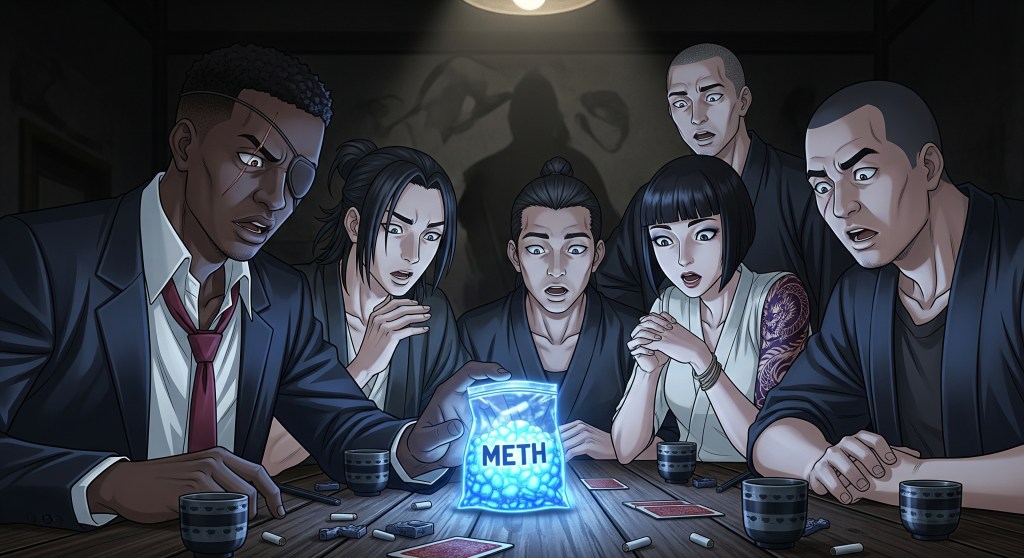
この シャブ は けっこう じゅんど が たかい らしい。
Kono shabu wa kekkou jundo ga takai rashii.
This meth is supposedly quite pure.
けっこう (kekkou) is a slick little word that can be used in a few different ways, but today we’re gonna focus on it as an adverb. When you use it like this, it means “quite a lot,” “pretty,” or “fairly.” It’s like a verbal head nod, a way of saying something is more than you expected, or that you’re cool with it. Think of it like this: if you’re asking your homie how a job went down, and he says, 「けっこう、やばかった。」, he’s saying it was “pretty crazy” or “fairly wild.” It ain’t as intense as “super wild,” but it’s more than just “a little wild.” It’s like putting a little extra bass on your words to make ’em hit harder.
Now, let’s get into how you can put this word to work. You ain’t gotta change nothing on it. You just drop it in before the word you wanna add emphasis to, like a G adding a fresh beat to a track.
| Meaning in English | Connecting to… | Example Sentence | Translation |
|---|---|---|---|
| quite, pretty, fairly | Verbs and Adjectives | そのえいがはけっこうおもしろかった Sono eiga wa kekkou omoshirokakatta. | The movie was quite interesting. |
Think of けっこう (kekkou) like the hype man of your sentences. You know how a good hype man gets the crowd ready, making a simple show feel like a massive event? That’s what けっこう (kekkou) does. It takes a regular ol’ word and hypes it up, giving it more weight and feeling. So when you say a task was けっこう (kekkou) hard, you’re not just saying it was difficult; you’re saying it was pretty difficult, like it took some real grind to get it done.
Now, check it. Before we get into these sentences, you need to know these words. It’s the language of the streets.
しつこい (Shitsukoi)
English: Persistent; insistent; tenacious; pushy.
This word is for someone who don’t know when to quit, ya dig? They on you, and on you, and on you again, like they ain’t got nothin’ else to do. Like that cat who keeps hittin’ you up for money even after you told ’em no a dozen times. That’s being shitsukoi. It ain’t just annoying; it’s straight-up relentless.
き が みじかい (Ki ga mijikai)
English: Short-tempered; impatient.
You know them dudes who go from zero to a hundred in a split second? One minute they chillin’, the next they about to blast off over somethin’ small? They got a short fuse, man. That’s what this means. They don’t got the patience for nothin’. One wrong look and they ready to wild out. Think Ice Cube in Boyz n the Hood—that’s that ki ga mijikai energy right there.
てきたい する (Tekitai suru)
English: To be hostile; to be an enemy.
This is when you got beef with someone. It’s that feeling you get when you see a rival crew roll up. You ain’t on the same team, and it’s understood. You are tekitaishiteru. Y’all got that animosity, that tension, that “I’m not feelin’ you” vibe. It’s more than just dislike; it’s straight-up opposition.
もめごと (Momegoto)
English: Trouble; dispute; quarrel; conflict.
This is the drama, the mess, the static. It’s when things get all twisted up and it ain’t smooth no more. A momegoto is a problem, an argument, or a fight between people. It’s that thing that happens when two crews bump heads over territory. It ain’t just a small misunderstanding; it’s a whole situation that needs to be handled.
けじめ を つける (Kejime o tsukeru)
English: To draw a clear line; to take responsibility; to make a clean break.
This is about havin’ honor, my dude. It’s when you gotta do what’s right, even if it’s tough. You gotta face the music and deal with the consequences of your actions. It’s also about makin’ a clean break from somethin’ or someone. Like if you mess up, you gotta kejime o tsukeru—you gotta own that and fix it. Or if you’re leavin’ the game, you gotta do it proper and make it final. It’s all about that sense of responsibility and finality.
And now, for the main event. Peep these examples, and you’ll be on your way to sounding like a boss.
とりひき は けっこう むずかしかった。
Torihiki wa kekkou muzukashikatta.
The deal was quite difficult.
おれたち の なわばり は けっこう ひろく なった。
Oretachi no nawabari wa kekkou hiroku na’tta.
Our territory has become quite wide.
きのう の やつ は けっこう しつこかった。
Kinou no yatsu wa kekkou shitsukokatta.
That guy from yesterday was pretty persistent.
くみちょう は けっこう き が みじかい から き を つけろ。
Kumichou wa kekkou ki ga mijikai kara ki o tsukero.
The boss has a pretty short temper, so watch out.
てきたい する そしき は けっこう かね を もって’る。
Tekitai suru soshiki wa kekkou kane o mo’tte’ru.
The rival organization has a lot of money.
きょう の もめごと は けっこう たいへん だった な。
Kyou no momegoto wa kekkou taihen da’tta na.
Today’s conflict was quite tough, wasn’t it?
あにき は けっこう かんたん に けじめ を つけた。
Aniki wa kekkou kantan ni kejime o tsuketa.
My big bro quite easily settled the dispute.
タマ を とる には けっこう じゅんび が ひつようだ。
Tama o toru niwa kekkou junbi ga hitsuyou da.
Killing someone requires quite a bit of preparation.
あの しんいり の ヒットマン は けっこう うで が たつ。
Ano shin’iri no hittoman wa kekkou ude ga tatsu.
That new hitman is quite skilled.
あの そしき は けっこう きびしい おきて が ある。
Ano soshiki wa kekkou kibishii okite ga aru.
That organization has pretty strict rules.
Peace out.


Leave a comment