

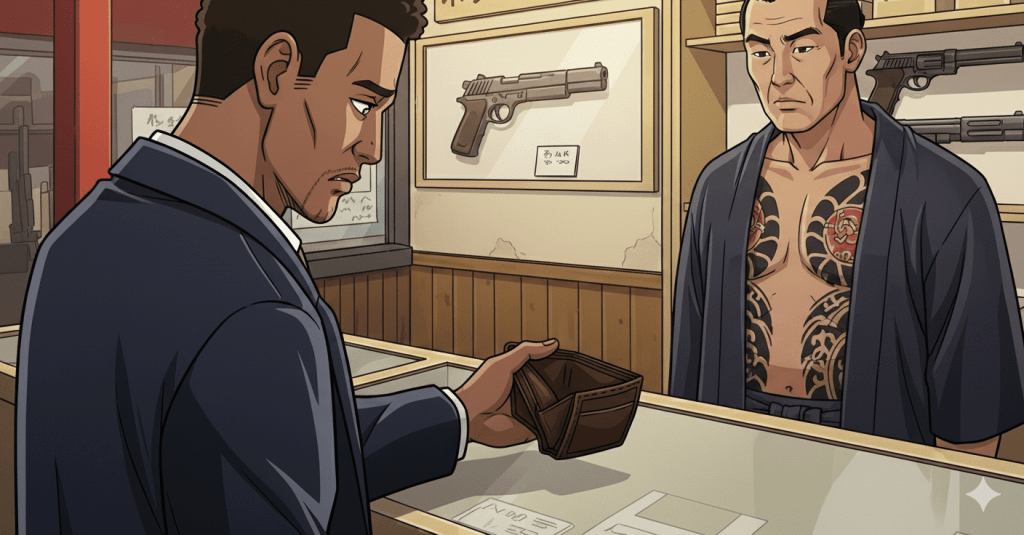
お金がなくて、新しい銃が買えないんだ。
I don’t have money, and I can’t buy a new gun.

You got some problems, right? Like you ain’t got no cash and you can’t cop a whip. Or maybe you’re not feelin’ so hot, so you can’t roll with the crew. なくて is that link, that chain that connects two bad situations. It’s like tellin’ your homie, “I ain’t got the dough, and I can’t get that new ride.” That’s the vibe. It’s for when you’re tryna say somethin’ ain’t happenin’, and because of that, somethin’ else is messed up too. It’s all about that cause and effect, ya know? The first thing is the reason for the second thing goin’ south.

I’mma break down the conjugation for ya, so you don’t mess it up and look like a chump. Pay attention.
| Word Type | Conjugation | Examples | Translation |
|---|---|---|---|
| い-Adjective Drop the い from the negative くない form, and add くて | 忙しい → 忙しくない → 忙しくなくて | 忙しくなくて、映画が見られた。 | I wasn’t busy, so I could watch the movie. |
| Verb Drop the い from the negative ない form, and add くて | 行く → 行かない → 行かなくて | 行かなくて、正解だった。 | It was the right choice not to go. |
| Noun Add でなくて | 友達 → 友達でなくて | 彼女は友達でなくて、ただの知り合いだ。 | She’s not a friend, just an acquaintance. |
| な-Adjective Add でなくて | 静か → 静かでなくて | その場所は静かでなくて、話ができなかった。 | That place wasn’t quiet, so we couldn’t talk. |
When you’re puttin’ this together, you gotta remember a couple of things. For the い-Adjectives, it’s a simple swap, you feel me? You just kick that い to the curb and bring in なくて. It’s easy money. Now, for the verbs, you gotta be slick. First, you gotta flip the verb into its negative form with ない, then you treat that ない just like an い-Adjective and do the same thing. And for the nouns and な-Adjectives, it’s all about that でなくて. You just slap that right on the end. It’s a whole different game, but the rules are simple.
Think of なくて like a dead-end street. You’re comin’ down the block, and you hit that dead-end. You can’t go any further, and because of that, you gotta turn back or find another way. The first part of the sentence is that dead-end, and the second part is the result of hittin’ it. It’s a roadblock, and it stops you from gettin’ to where you wanna be.

Words straight from the concrete jungle, so you can speak the real.
ダサい (ださい)
English: Lame; wack; uncool.
This one’s for real. You know how some dudes just ain’t got the style, the drip, the swagger? They be lookin’ all goofy, rockin’ stuff that went out of style a decade ago. That right there? That’s dasai. It ain’t just about clothes, though. It’s about a weak mindset, a corny plan, or just bein’ a straight-up square. If it ain’t fresh, if it ain’t official, it’s dasai.
迷惑な (めいわくな)
English: Bothersome; a nuisance; annoying.
This is what you call it when someone’s gettin’ on your last nerve. You tryin’ to handle your business, lay low, but some clown keeps buggin’ you, gettin’ in your way, makin’ noise. That’s meiwakuna. It’s that dude who shows up uninvited to the spot, the cops rollin’ up when you’re tryna make a move, or a snitch droppin’ dimes. It ain’t just annoying; it’s a problem, somethin’ you gotta deal with to get back to the grind.
ふざける
English: To mess around; to act foolish; to play a joke.
Listen up. When you hear this, someone’s gettin’ out of pocket. It could be harmless, like your boy clownin’ around, talkin’ smack for laughs. But it can be serious, too. It’s when someone ain’t takin’ a situation seriously, disrespectin’ the game, or straight up playin’ you for a fool. When you tell a dude to stop playin’, you tellin’ him to stop fuzakeru. It’s a warning, a heads-up to cut the crap before things get real.
追跡 (ついせき)
English: Pursuit; a chase; to track down.
This is all about the hunt, the chase. When you’re on the streets, it’s always one of two things: you either tsuiseki someone or you gettin’ tsuiseki’d. It’s when the heat is on your tail, tryin’ to follow your every move. Or maybe you’re the one on the hunt, trackin’ down a rat who crossed you or a rival crew who stepped on your turf. It’s that adrenaline, that game of cat and mouse where you gotta stay one step ahead or get caught slippin’.
指輪 (ゆびわ)
English: A ring.
This ain’t just some jewelry. A yubiwa can mean a lot of things. It could be that big, flashy rock on your hand, showin’ everyone you got money. It’s a statement of power, of wealth. Or it could be a sign of a real official connection, like a wedding ring. It’s a promise, a bond you made. In our world, it’s about what you wearin’ that says you’re legit. It shows you’re not playin’ games.
Yo, check out these rhymes.
このスーツは格好良くなくて、ダサいぜ。
This suit ain’t cool, it’s wack.
彼は俺の敵でなくて、ただの迷惑な奴だ。
He ain’t my enemy, he’s just an annoying dude.
仲間は真面目でなくて、いつもふざけている。
My crew ain’t serious, they’re always messin’ around.
俺の車が速くなくて、追跡から逃げられなかった。
My car wasn’t fast, so I couldn’t escape the chase.
誰も俺に金を貸してくれなくて、困っているんだ。
No one would loan me money, and I’m in trouble.
その指輪は本物でなくて、ただのガラスだった。
That ring wasn’t real, it was just glass.
警察が賢くなくて、簡単に逃げられたぜ。
The cops ain’t smart, so we got away easy.
拳銃が重くなくて、子供のおもちゃみたいだぜ。
This pistol ain’t heavy, it’s like a kid’s toy.
今日は暇でなくて、あんたとは遊べない。
I ain’t free today, so I can’t hang with you.
その仕事は簡単でなくて、めちゃくちゃ難しかった。
That job wasn’t easy, it was crazy difficult.
Aight, that’s the word. Don’t be a square and mess this up. Later, fam. Peace.

Leave a comment