

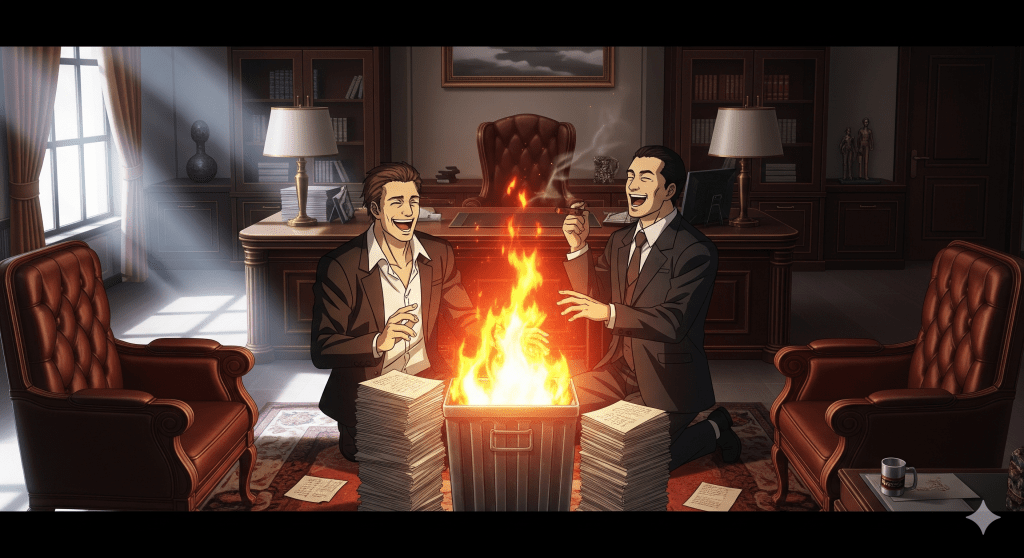
証拠をすべて燃やした。それで、警察は何も見つけられなかった。
We burned all the evidence. Because of that, the police couldn’t find anything.

Right then, what’s the goss on 「それで」? In a nutshell, it’s your go-to for “because of that,” “so,” or “that’s why.” It connects two ideas, but it ain’t just any connection, you get me? The first sentence is the cause, the reason why something went down. The second sentence is the result, the consequence, the whole shebang that happened ’cause of the first thing. It’s all about cause and effect, one thing leading straight to another. If you’ve done something and there’s a direct result, this is the word you’re gonna use to link it all up. It’s dead simple, but proper crucial for telling a story straight. Don’t get it twisted.
NUANCE – THE THREE CONTENDERS
There are a few ways to explain reasons in N4 and each of these has its own flavour, its own way of doing things. You gotta know when to use the right tool for the job.
それで (Sorede): The Narrator We’ve been over this one. 「それで」 is the storyteller. It links two separate sentences. Fact A happened. As a result, Fact B happened. It’s objective, like a CCTV recording of events. “The alarm went off. So, we had to scarper.” It’s just reporting the chain of events. No emotion, just cold, hard facts.
ので (Node): The Diplomat This is your polite explanation. It’s when you give a reason that’s presented as a natural, unavoidable fact. It’s softer, a bit more formal. You use it when you want the listener to understand your situation. 「ので」 lowers the boom gently. “Seeing as the coppers are swarming Ikebukuro West Gate Park, we’ll have to meet somewhere else.” It’s giving a justification, making the result sound logical and expected.
から (Kara): The Gaffer Now, 「から」 is the most direct of the lot. It’s you, stating your reason, your personal opinion for why something is happening. It’s subjective as hell. This is the one you use when you’re making a point, giving an order, or stating your will. “I’m the boss, that’s why you’ll do as I say!” It strongly pushes your personal reason forward. Because of this, you can stick commands, requests, and suggestions right after it. It’s got a bit of an edge to it.

Here’s the lowdown on how to stick this into a sentence.
| Sentence 1 (Cause) | Conjunction | Sentence 2 (Effect) | English Translation |
| 宿題を忘れた。 | それで、 | 先生に怒られた。 | I forgot to do my homework. So, the teacher got mad at me. |
| 電車が遅れた。 | それで、 | 会議に間に合わなかった。 | The train was late. So I missed the meeting. |
| 金がなかった。 | それで、 | 何も買えなかった。 | I had no money. So I couldn’t buy anything. |
See? It’s a piece of cake. 「それで」 is a conjunction, a linking word. It doesn’t conjugate or change its clobber, no matter what you stick before or after it. It just sits pretty between two complete sentences. The first sentence lays out the situation, the reason, the drama. Then you drop 「それで」 like you’re dropping a beat, and follow it up with the outcome. Sentence A happens, and because of that, Sentence B happens. Simple as.
Think of it like this: 「それで」 is like a getaway driver. You’ve got the first sentence, which is the bank job you’ve just pulled off – that’s the cause, the action. Now you need to get to the consequence, which is legging it back to the safehouse with the loot. 「それで」 is the motor that links the job to the getaway. Without the driver, you’re just standing outside the bank looking like a lemon. It connects the ‘why’ to the ‘what happened next’. The job’s the reason, the getaway’s the result. Proper job.

Here’s some new lingo for your vocab list, you’ll see it in the examples below.
ダチ (だち)
English: Mate; pal; homie.
Right then, your “dachi” is your crew, your inner circle. These ain’t just your average mates you have a pint with down the pub. Nah, these are the lads you roll with, the ones who’ve got your back when things get heavy. Your firm, your ends, the ones you trust with the business, no questions asked. If you’re in a tight spot, your dachi are the first ones you’re calling. Solid as a rock, you get me?
口答えする (くちごたえ する)
English: To talk back; to answer back.
See, when some young buck starts “kuchigotae suru,” they’re getting lippy. They’re giving you backchat. You’re the guv’nor, you lay down the law, and this little upstart starts chirping, questioning your authority right to your face. It’s a proper lack of respect, and in our game, that kind of cheek gets you a one-way ticket to a slap. You don’t answer back to the top boy. Simple as.
シメてやる (しめてやる)
English: To sort someone out; to teach someone a lesson (often physically).
Now, if someone’s been getting on your nerves, maybe giving you a bit of that “kuchigotae,” you might have to “shimete yaru.” This is about putting someone in their place, yeah? Sorting them out proper. It ain’t a friendly chat. It’s a promise. It means you’re about to deliver a bit of discipline, a bit of the old ultraviolence to remind ’em who’s boss. It’s a necessary part of business, innit? Keeps everyone in line.
裏取引 (うらとりひき)
English: Backroom deal; shady transaction.
An “uratorihiki” is the kind of business that don’t see the light of day. This ain’t happening on the high street with receipts and all that rubbish. This is a backroom deal, under the table. It’s the dodgy stuff, the real graft. Moving gear, exchanging info, making alliances with other firms… it all goes down quiet-like, away from the coppers and the taxman. It’s how empires are built, one dodgy handshake at a time.
偉そう (えらそう)
English: To act superior; to be arrogant.
You know when you see some geezer puffing his chest out, acting like he’s the king of the world? That’s “erasou.” He’s acting all high and mighty, looking down his nose at everyone else like they’re dirt on his shoe. In this life, a bit of confidence is one thing, but being “erasou” is just asking for trouble. It’s a sign of weakness, trying to act bigger than you are. And people who act like that? They tend to get brought back down to earth, sharpish.

Alright, get your peepers on these examples.
金が全然なかった。それで、友達に借りた。
I was completely skint. So, I borrowed some money from a friend.
昨日は飲みすぎた。それで、今日は二日酔いだ。
I drank too much yesterday. Because of that, I’m hungover today.
あいつは俺のダチに口答えした。それで、少しシメてやった。
That guy talked back to my mate. So, I taught him a little lesson.
裏取引が警察にバレた。それで、幹部たちが一斉に逮捕された。
The secret deal was exposed to the police. As a result, the top brass were all arrested at once.
重要な情報を盗んだ。それで、組織から追われる身となった。
I stole important information. Because of that, I’m now being hunted by the organisation.
彼は組織のルールを破った。それで、指を詰めさせられた。
He broke the organisation’s rules. Therefore, he was made to cut off his finger.
あの男は警察のスパイだった。それで、彼をコンクリート詰めにしなければならなかった。
That man was a police informant. Because of that, we had to encase him in concrete.
銀行強盗の計画は完璧だった。それで、大金を手に入れた。
The plan for the bank robbery was flawless. As a result, we got a massive amount of cash.
彼は我々のボスを裏切った。それで、消されることになった。He betrayed our boss. Therefore, it was decided he would be eliminated.
あいつはいつも偉そうだ。それで、誰もあいつを好かない。
He’s always acting like the big man. That’s why nobody likes him.
Right, that’s your lot for today. Get that in your head and start using it, yeah? Don’t be a div.

Leave a comment