

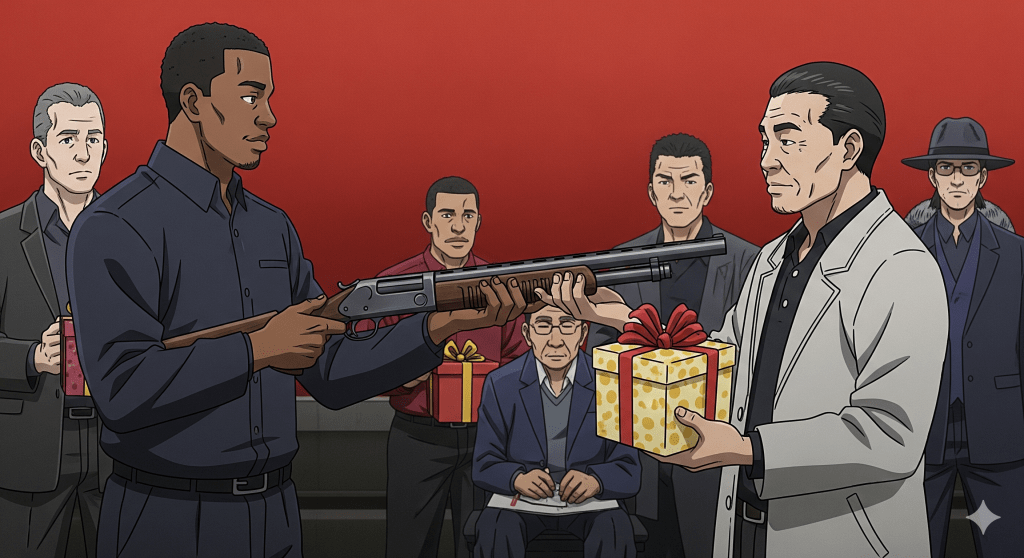
あいつが新しい銃を買ってくれたんだ。
That guy bought me a new gun.

See, in this game, it’s all about who’s got your back. Think of it like a favor. When someone does somethin’ for you, you can use てくれる (te kureru) to show you appreciate that they stepped up. It’s like when my man Paulie from Goodfellas looks out for Henry Hill, or when the Wu-Tang Clan drops a beat for a brother. Someone’s doin’ you a solid, and you’re the beneficiary.
Now, listen up, ’cause this is crucial. てくれる (te kureru) is one of the most casual ways to get a favor from a homey. It’s like てもらう (te morau), but even that’s a little more polite. If you wanna show some real respect, like to the boss or a made man, you’d use ていただく (te itadaku). That’s the humble-speak version, ya dig?
And when you’re talkin’ to your crew, your closest boys, you can even cut it down to just てくれ (te kure). That’s some real street talk, like sayin’, “Would ya do this for me?” or “Could ya do that for me?” You wouldn’t use that with some rival crew or a detective, though. That’s the kinda lingo you save for the people who got your back, no questions asked.

Here’s how you put it together. Just take the te-form of any verb and stick くれる (kureru) right on the end. Easy peasy.
| Verb Type | Japanese | English |
| Group 1 (u-verbs) | 書く → 書いてくれる | to write (for me) |
| 持つ → 持ってくれる | to hold (for me) | |
| 読む → 読んでくれる | to read (for me) | |
| Group 2 (ru-verbs) | 教える → 教えてくれる | to teach (for me) |
| 食べる → 食べてくれる | to eat (for me) | |
| 見せる → 見せてくれる | to show (for me) | |
| Irregular Verbs | する → してくれる | to do (for me) |
| 来る → 来てくれる | to come (for me) |

Think of てくれる (te kureru) like this: it’s the Japanese equivalent of someone “doing you a solid.” You’re the one on the receiving end, the lucky dog who got a favor. The verb くれる (kureru) literally means “to give” when it’s comin’ from someone else to you. So when you slap the te-form of another verb in front of it, you’re sayin’, “They gave me the act of doin’ this thing.” It’s smooth, man. Real smooth. This whole structure has the feel of “for me” built right into it. You don’t even gotta say it, ’cause it’s already there, slick like a fresh pair of Timbs.

Peep these words, they might just save ya life.
面倒を見る (めんどう を みる)
English: To take care of someone or something; to look after.
Yo, when you say you “take care” of someone, you ain’t just talkin’ ’bout a babysitter. In the streets, this means you’re holdin’ it down for your people. You’re lookin’ out for your crew, makin’ sure they eatin’, stayin’ safe, and got their back, no matter what. It’s that real family kinda love, the loyalty that runs deep. You watch their back, they watch yours.
逃走用の車 (とうそうよう の くるま)
English: Getaway car; escape vehicle.
A getaway car is the ride that gets you outta there fast after a job goes down. It’s gotta be somethin’ low-key, somethin’ you can lose in a second, but it also gotta have that horsepower to outrun the boys in blue. You line it up beforehand, engine runnin’, ready to mash the gas and disappear into the night. It’s your ticket to freedom, for real.
兄貴 (あにき)
English: Older brother; big bro.
In the hood, “aniki” ain’t just your blood brother. This is the big homie, the one you respect, the one who’s been around the block a few more times than you. He’s the one you go to for advice, the one who shows you the ropes, and the one who has your back when things get sticky. He’s the leader, the OG, the one who’s earned his stripes.
アリバイ (ありばい)
English: Alibi.
An alibi is your proof that you were somewhere else when somethin’ went down. When the heat starts askin’ questions, you gotta have a solid story, somethin’ that puts you far away from the scene of the crime. Your homies gotta back you up, swearin’ you were chillin’ with them all night. It’s your shield, your get-out-of-jail-free card.
刑務所 (けいむしょ)
English: Prison; jail.
The “keimusho”… that’s the big house, the penitentiary. It’s where they send you when your luck runs out and the law finally catches up. It’s a dark place, a concrete jungle full of rules and hard time. It’s a whole different world, a place you wanna do whatever you can to avoid. But if you get sent up, you gotta find a way to survive and come out even stronger.
Here are 10 examples of how we use てくれる (te kureru) when we’re talkin’ business.
兄貴が車を隠してくれた。
My big brother hid the car for me.
仲間がアリバイを作ってくれた。
My crew made an alibi for me.
彼女はいつも俺の面倒を見てくれる。
She always takes care of me.
ボスは俺を信じてくれない。
The boss doesn’t believe me.
友達が逃走用の車を運転してくれた。
My friend drove the getaway car for me.
彼は俺の荷物を運んでくれる。
He will carry my luggage.
刑務所の友達が連絡してくれた。
My friend from prison contacted me.
彼女が警察から逃がしてくれた。
My girl helped me escape from the police.
誰が俺を裏切ったか教えてくれるか?
Will you tell me who betrayed me?
組織の奴らが俺を助けてくれるかな。
I wonder if the guys from the organization will help me.
Alright, stay real and stay sharp. Don’t be makin’ no moves without knowin’ the score. Catch you on the flip side.


Leave a comment