

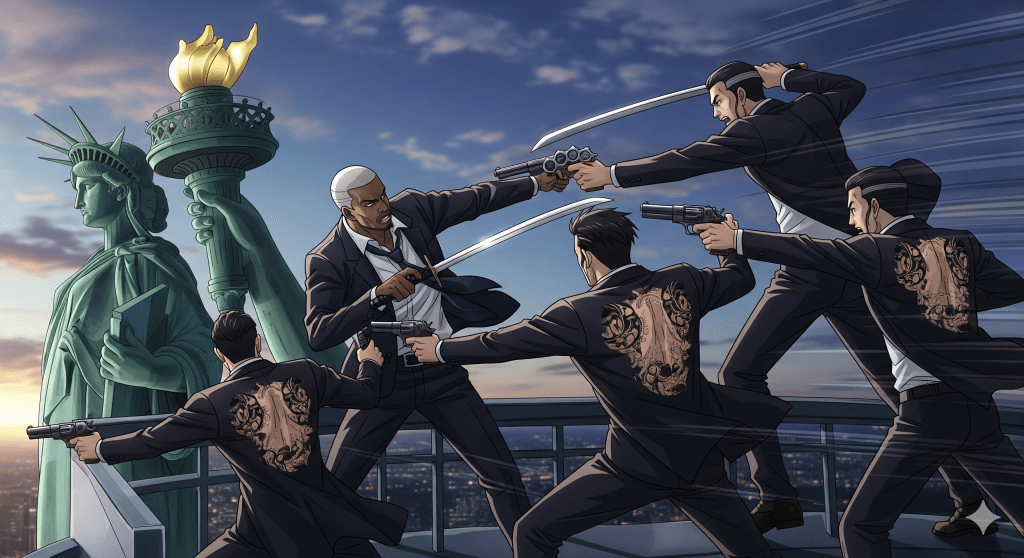
むかし の ニューヨーク は きけんでした。
mukashi no nyuuyouku wa kiken deshita.
Old New York was dangerous.
So, check it. In Japanese, when you’re talkin’ about how something was, you gotta switch up the ending of your adjectives. Think of it like this: your adjective is your main man, your ace. The present tense is how he is right now, on the corner, doin’ his thing. The past tense is the story you tell about him later, ya know? “Man, he was cool.”
For some adjectives, you gotta swap the ending right on the word itself. That’s your ~かった (katta). For others, you keep the word as is and just add ~でした (deshita) at the end, like bringing your trusted consigliere to the sit-down. It’s all about knowing which crew your adjective rolls with.
Here’s the blueprint for how you flip these words from the present to the past.
| Adjective Type | Present Tense | Past Tense (Casual) | Past Tense (Polite) | English Translation |
| い-adjective | さむい (samui) | さむかった (samukatta) | さむかったです (samukattadesu) | was cold. |
| な-adjective | ゆうめい (yuumei) | ゆうめいだった (yuumei datta) | ゆうめいでした (yuumei deshita) | was famous. |
Alright, let’s break it down further. For your い-adjectives (i-adjectives), the ones that end in that い (i) sound, you drop that ‘i’ and smack ‘かった’ (katta) on the end. It’s a straight swap. So, ‘atsui’ (hot) becomes ‘atsukatta’ (was hot). Easy money. If you wanna be polite about it, like you’re talkin’ to the Don, you just add ‘desu’ after ‘katta’. So, ‘atsukattadesu’. Now, there’s one irregular cat you gotta watch out for: いい (ii), which means ‘good’. This dude changes his whole name when he goes past tense. He becomes よかった (yokatta). Don’t ask why, he just does. He’s like a witness in protection.
For your な-adjectives (na-adjectives), these are the words that you usually see with a な (na) when they’re describing a noun. When they’re at the end of a sentence, they just chill. To make ’em past tense, you don’t even touch the word. You just bring in the muscle: でした (deshita) for polite situations, or だった (datta) if you’re just choppin’ it up with your crew. So, ‘shizuka’ (quiet) becomes ‘shizuka deshita’ (was quiet). The adjective itself is untouchable, like a made man.
Here’s the metaphor, see? Think of i-adjectives as your independent street soldiers, like a young Nas outta Queensbridge. They handle their own business. To make ’em past tense, they change themselves. They drop that final ‘i’ and bring in their own muscle, ‘katta’. But na-adjectives? They’re like the big bosses, the capos. They don’t get their hands dirty. They just call in their enforcer, ‘deshita’, to come in and handle the past tense business for them. Simple as that.

Yo, what up, fam? Vocab in the house. Let’s break down these words, street style. Peep this.
とりひき (Torihiki)
English: Deal; transaction.
Aight, listen up. A “torihiki” is a deal, a transaction, the kinda thing that goes down to move product and get that paper. It ain’t no handshake at the corner store; we talkin’ major moves. This could be the handoff, the exchange, the kinda deal you see in the back of a tinted-out Maybach. It’s all about the art of the deal, making sure you come out on top, whether it’s legal or, you know, less than legal. Every kingpin, every CEO, every hustler on the block lives and dies by the “torihiki.” You feel me?
びんぼう (Binbou)
English: Poor; broke.
“Binbou” is when you’re flat broke, man. Your pockets are empty, and the fridge is lookin’ sad. It’s that “started from the bottom” life. We ain’t talkin’ about bein’ a little short on cash; we talkin’ ’bout genuine struggle. But yo, that struggle? That’s what builds character. It’s the fire that fuels the hustle, the motivation to grind hard so you never have to be “binbou” again. It’s the backstory to every great come-up story.
けいさつ (Keisatsu)
English: Police.
“Keisatsu,” aight, that’s the Five-O, the boys in blue, the Feds. You hear sirens wailin’? That’s the “keisatsu” pullin’ up. They’re the ones you gotta watch out for when you’re makin’ moves. They be rollin’ deep, tryin’ to shut down the whole operation. Whether you call ’em cops, the law, or whatever, their game is to keep the streets in check, and a real G knows how to move smart and stay one step ahead.
きびしい (Kibishii)
English: Strict; harsh.
“Kibishii” is how you describe somethin’ that’s harsh, strict, no-nonsense. Think of a judge handin’ down a heavy sentence, that’s “kibishii.” Or the unwritten rules of the street—you break ’em, the consequences are “kibishii.” It’s that tough-love, no-room-for-error vibe. The world’s cold, and sometimes life hits you with that “kibishii” reality check to see if you’re built for it.
けいむしょ (Keimusho)
English: Prison; jail.
“Keimusho.” That’s the pen, the joint, the big house. It’s where you end up if you get caught slippin’ and the “keisatsu” slap the cuffs on you for good. We’re talkin’ lockdown, behind bars, doin’ hard time. It ain’t no vacation. A lot of cats come out harder, some don’t come out at all. It’s the place every hustler is tryin’ to avoid, the ultimate price you pay for livin’ that life on the edge. Straight up.
Here are some lines you might hear in the back alleys of Shibuya… or maybe the Bronx.
きのう の とりひき は かんたんだった ぜ。
kinou no torihiki wa kantan datta ze.
Yesterday’s deal was easy, yo.
のマフィアのボスはゆうめいでした。
ano mafia no bosu wa yūmei deshita.
That mafia boss was famous.
わかい ころ、 かれ は びんぼうだった。
wakai koro, kare wa binbou datta.
When he was young, he was poor.
パーティーはとても たのしかった です。
paatii wa totemo tanoshikatta desu.
The party was a lot of fun.
けいさつ は きびしかった。
keisatsu wa kibishikatta.
The cops were strict.
かくれが は しずかでした。
kakurega wa shizuka deshita.
The safe house was quiet.
けいむしょ で の せいかつ は たいへんでした。
keimusho de no seikatsu wa taihen deshita.
Life in prison was tough.
きょねん の ふゆ は とても さむかった。
kyonen no fuyu wa totemo samukatta.
Last winter was very cold.
その ほうせき は きれいだった なあ。
sono hōseki wa kirei datta nā.
Those jewels were beautiful, weren’t they?
かれ の かお は あかかった。
kare no kao wa akakatta.
His face was red.
Aight, that’s the 4-1-1 for today. Study up. You mess this up, and you’ll be sleepin’ with the fishes, grammatically speaking.
Keep your head up, and your Japanese sharp. Peace out, stay real.

Leave a comment