

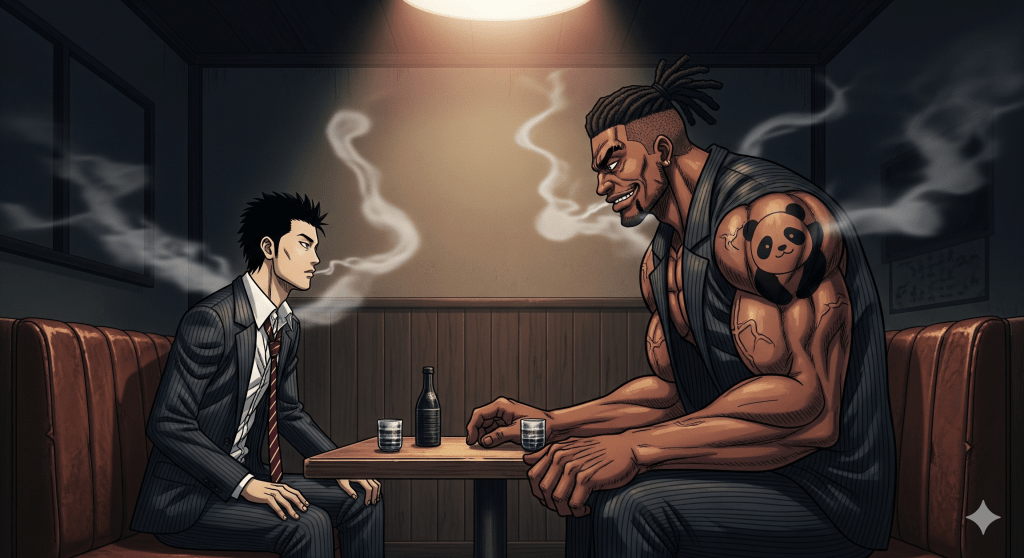
あの おとこ の タトゥー は こわくなかった。
ano otoko no tatuu wa kowakunakatta.
That guy’s tattoo wasn’t scary.
Yo, so check it. In the world of Japanese grammar, you got two main crews of adjectives: the i-adjectives and the na-adjectives. Think of ’em like two different families in a mob movie. They both gotta pay their respects to the past tense, but they do it in their own way.
When you wanna say something wasn’t a certain way, you gotta use the right tool for the job. If you’re dealing with an i-adjective, you bring in the enforcer, ~くなかった (kunakatta). For the na-adjectives, you call up the consigliere, ~じゃなかった (janakatta). It’s all about knowing which family you’re dealing with.
Here’s the cheat sheet so you don’t get clipped by some bad grammar.
| Adjective Type | Present Affirmative | Past Negative | English |
| i-adjective | さむい (samui) | さむくなかった (samukunakatta) | wasn’t cold. |
| na-adjective | ゆうめい (yuumei) | ゆうめいじゃなかった (yuumei ja nakatta) | wasn’t famous. |
For the i-adjectives, you drop the final ‘い’ (i) and smack that ~くなかった (kunakatta) on the end. It’s like taking the silencer off one gun and putting it on another. For the na-adjectives, you just leave the word as is and add ~じゃなかった (ja nakatta). Easy money. Remember the one exception, the renegade: いい (ii) becomes よくない (yokunai) in the negative, so the past negative is よくなかった (yokunakatta). Don’t forget that, or you’ll look like a real chump.
Think of it like this: you’re planning a big score, right? The “before” is the present tense. The “after” is the past tense. Now, let’s say the plan goes south. The vault wasn’t easy to crack. The getaway car wasn’t fast.
That’s where ~くなかった (kunakatta) and ~じゃなかった (janakatta) come in. They’re like the after-action report for a failed job. They tell you how things weren’t. You thought the job was gonna be “easy” (かんたん – kantan), but it wasn’t easy (かんたんじゃなかった – kantan ja nakatta). You thought the lookout was gonna be “good” (いい – ii), but he wasn’t good (よくなかった – yokunakatta). It’s all about describing a past reality that didn’t live up to the hype.
Ayo, here’s some new slang for your vocabulary. Don’t be a slouch, learn this stuff.
きげん (Kigen)
English: Mood; temper; humor.
Yo, “kigen” is all about the vibe someone’s puttin’ out, ya dig? It’s their mood, how they feelin’ at the moment. If your boss is in a good kigen, it’s all smooth sailin’, you can probably ask for that raise. But if they got a bad kigen, you best step off, ’cause things could get ugly real quick. It’s like checkin’ the temperature of the room before you make your move. You don’t wanna walk into a hot situation cold, feel me?
さくや (Sakuya)
English: Last night.
Aight, listen up. “Sakuya” is all about what went down when the sun was out of sight. We talkin’ ’bout last night. The deals that were made, the party that popped off, the whole scene after dark. It ain’t yesterday, it’s that specific time when the city lights come on and the real players come out. So when someone asks what you did “sakuya,” you better have a good story or a solid alibi.
かいごう (Kaigou)
English: Meeting; gathering.
Check it, “kaigou” is when the crew gets together. This ain’t no random hangout, it’s a sit-down, a formal meet-up. Think like a G7 summit, but for the streets. The bosses, the capos, the main hustlers—they all pull up to the “kaigou” to talk strategy, make big decisions, and make sure everyone’s on the same page. It’s about power, respect, and makin’ moves that are gonna shake things up.
らく (Raku)
English: Easy; comfortable.
“Raku” is that feeling when everything’s smooth, no stress, no grind. It’s that easy money, that cushy lifestyle. When a job is “raku,” it’s a cakewalk, a piece of cake. Everyone’s chasing that “raku” life, where you can kick back, stack your paper without breakin’ a sweat, and just enjoy the ride. But don’t get it twisted, nothin’ worth havin’ comes that easy. You gotta put in the work to get to that “raku” state of mind.
じょうほう (Jouhou)
English: Information; intelligence.
Yo, “jouhou” is the real currency on the streets, straight up. It’s the info, the intel, the 4-1-1. Who’s movin’ where, what the cops know, who’s got the connect—that’s all “jouhou.” Havin’ the right “jouhou” is what separates the kingpins from the corner boys. It’s power. You can make or break someone with the right piece of information. So you gotta keep your ears to the ground and your mouth shut, you know what I’m sayin’? Knowledge is everything in this game.
Peep these lines. This is how you talk when you’re recounting a story to your crew.
その しごと は らくじゃなかった。
sono shigoto wa raku ja nakatta.
That job wasn’t easy.
かれ は あまり しんせつじゃなかった。
kare wa amari shinsetsu ja nakatta.
He wasn’t very kind.
その バー は にぎやかじゃなかった。
sono baa wa nigiyaka ja nakatta.
That bar wasn’t lively.
まち は しずかじゃなかった。
machi wa shizuka ja nakatta.
The city wasn’t quiet.
かれ の パンチ は つよくなかった。
kare no panchi wa tsuyokunakatta.
His punch wasn’t strong.
その じょうほう は ただしくなかった。
sono jouhou wa tadashikunakatta.
That information wasn’t correct.
さくや の かいごう は ながくなかった。
sakuya no kaigou wa nagakunakatta.
Last night’s meeting wasn’t long.
ダイヤモンド は あまり おおきくなかった。
daiyamondo wa amari ookikunakatta.
The diamond wasn’t that big.
その しごと は むずかしくなかった。
sono shigoto wa muzukashikunakatta.
That job wasn’t difficult.
ボス の きげん は わるくなかった。
bosu no kigen wa warukunakatta.
The boss’s mood wasn’t bad.
Aight, that’s the lesson for today. Keep your head up, practice this stuff, and don’t be a stranger to these streets. Holla at ya boy next time. Peace out.

Leave a comment