

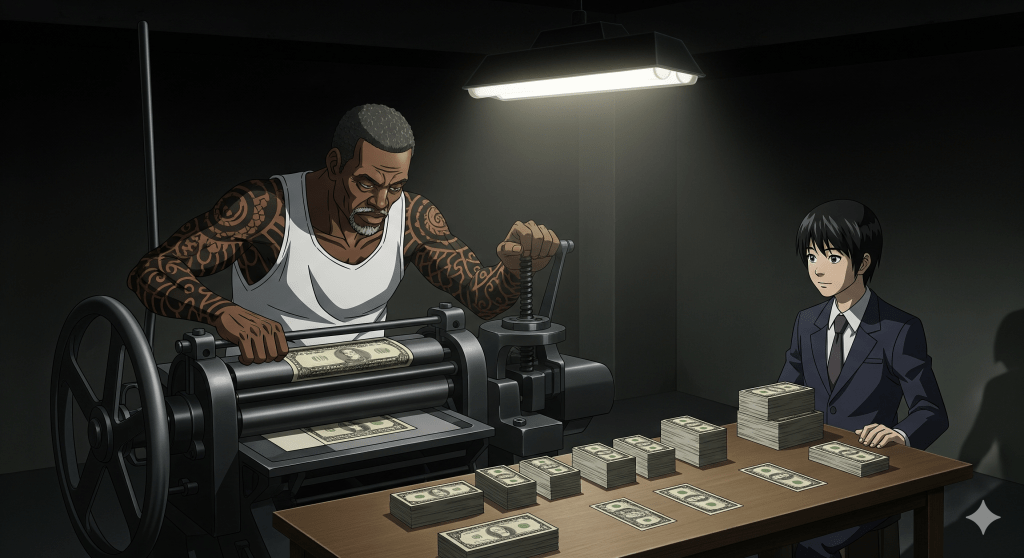
偽札作りの技術がだんだん向上している。
My counterfeiting skills are gradually improving.
Yo, so check it. 「だんだん」 is all about things changin’, but not like bam, not like a snap of the fingers. Nah, this is a slow burn. It’s that gradual come-up. Think about how a crew slowly takes over a neighborhood, block by block. Or how the feds build a case, piece by piece. It ain’t sudden. It’s that “little by little,” “step-by-step” action.
It’s like in Paid in Full, Rico didn’t just become the king of Harlem overnight. Nah, son. He was makin’ moves, stackin’ paper, and his influence grew だんだん. One day you’re small time, then you look up and you’re runnin’ the whole show. That’s the vibe. It’s the process, the grind. You feel me? It shows you somethin’ is in motion, headed for a new state of being.
Peep this. Here’s how you wire this thing up with your verbs.
| Form | Example | Translation |
| Present Progressive | だんだん寒くなってきた。 | It’s gradually gettin’ colder. |
| Past Tense | だんだん彼の話が分かってきた。 | I gradually came to understand his story. |
| Plain Form | だんだん日本語が上手になる。 | My Japanese will gradually get better. |
Now, let’s break it down. 「だんだん」 is an adverb, a word that describes the action. That means it don’t change itself, you hear? It’s a lone wolf. It just posts up at the beginning or before the verb to show how the action is happening: gradually. It plays real nice with verbs that show a change, like なる (to become) or verbs in the 〜てくる / 〜ていく form, which show a change happening over time and continuing. So you just drop 「だんだん」 in the sentence, and boom, you’re showin’ that slow creep. Easy money.
Alright, lemme drop a metaphor on you so this sticks. Think of 「だんだん」 like a pot of water you put on the stove before you make spaghetti for the crew. You turn on the heat, but it ain’t boiling right away, right? First, you see nothin’. Then, you see a few tiny bubbles. Then a few more. The water gets だんだん hotter, the bubbles get だんだん bigger, until the whole thing is rollin’. That’s 「だんだん」—that slow, steady change until you hit the boiling point. It’s the build-up before the big score.
Here’s some new vocab to add to your arsenal.
包囲網 (ほういもう)
English: Encirclement; dragnet.
Aight, listen up. “Houimou” is when the feds, the ops, whoever, got you boxed in. It’s that moment in the flick when the protagonist is holed up and you see squad cars pulling up from every direction, choppers in the sky. They building a net, a trap, and you the prize. There ain’t no way out, nowhere to run. They shuttin’ down the block, and you’re stuck in the middle. It’s checkmate, you feel me? The walls are closin’ in, straight up.
顔つき (かおつき)
English: Facial expression; look.
“Kaotsuki” ain’t just your face, it’s the whole story your face is tellin’. It’s that hard look you give a fool who’s talkin’ sideways. It’s the stink eye, the mean mug. When someone walks into the room and you know they ain’t about playin’ games just by their “kaotsuki.” It’s that non-verbal warning, that “don’t-even-try-it” vibe. It separates the real Gs from the studio gangsters. It’s all in the eyes, the set of your jaw. That’s the real communication right there.
逃亡生活 (とうぼうせいかつ)
English: Life on the run; fugitive life.
“Toubouseikatsu” is that life you gotta live after the heist goes wrong. You on the run, livin’ day to day, always lookin’ over your shoulder. You’re jumpin’ from motel to motel, usin’ fake IDs, payin’ in cash. Every knock at the door makes your heart jump. You can’t trust nobody. It’s that paranoid, high-stakes existence. No chill, no peace, just constant motion to stay one step ahead of the law. It’s the price you pay for the game.
所持金 (しょじきん)
English: Money on hand; cash in possession.
“Shojikin” is your roll, your bank, the paper you got in your pocket right now. This ain’t about your account balance or your credit score. This is the cold, hard cash you’re holding. It’s what you use to make things happen, to grease palms, to get what you need when you’re in a jam. When you’re in the streets, your “shojikin” determines your moves. It’s your lifeline, your get-out-of-jail-free card, your power right there in your fist.
チンピラ (チンピラ)
English: Hoodlum; punk; small-time gangster.
A “chinpira” is that wannabe, that small-time hustler tryna make a name for himself. He ain’t the boss, he ain’t even a made man. He’s the loudmouth on the corner, runnin’ low-level errands, maybe shakin’ down some local shop owner. He talks big, but he ain’t got the muscle or the brains to back it up. He’s a foot soldier, a pawn in the game. Think of him as the dude who gets taken out in the first five minutes of the movie to show you the real players mean business.
Here are some lines you might hear in the back alleys of Shinjuku.
彼は酒を飲むと、だんだん話が大きくなる。
When he drinks, he gradually starts to exaggerate his stories.
最初はただのチンピラだったが、彼はだんだん大物になった。
At first he was just a punk, but he gradually became a big shot.
あの新人はだんだん仕事に慣れてきた。
That new guy is gradually getting used to the job.
サイレンの音がだんだんこちらに近づいてくる。
The sound of sirens is gradually getting closer.
あの刑事、だんだん俺たちの動きに気づき始めたようだ。
It seems that detective has gradually started to notice our movements.
逃亡生活で、所持金がだんだん少なくなってきた。
On the run, my cash on hand has gradually dwindled.
敵のシマをだんだん奪っていく計画だ。
The plan is to gradually take the enemy’s territory.
彼は刑務所に入ってから、だんだん顔つきが変わった。
After he went to prison, his face gradually changed.
裏切り者の嘘がだんだん明らかになってきた。
The traitor’s lies are gradually coming to light.
警察の包囲網がだんだん狭まってきた。
The police dragnet is gradually closing in.
A’ight, that’s the lesson for today. Keep ya head up and ya grammar tight. The world is yours.

Leave a comment