

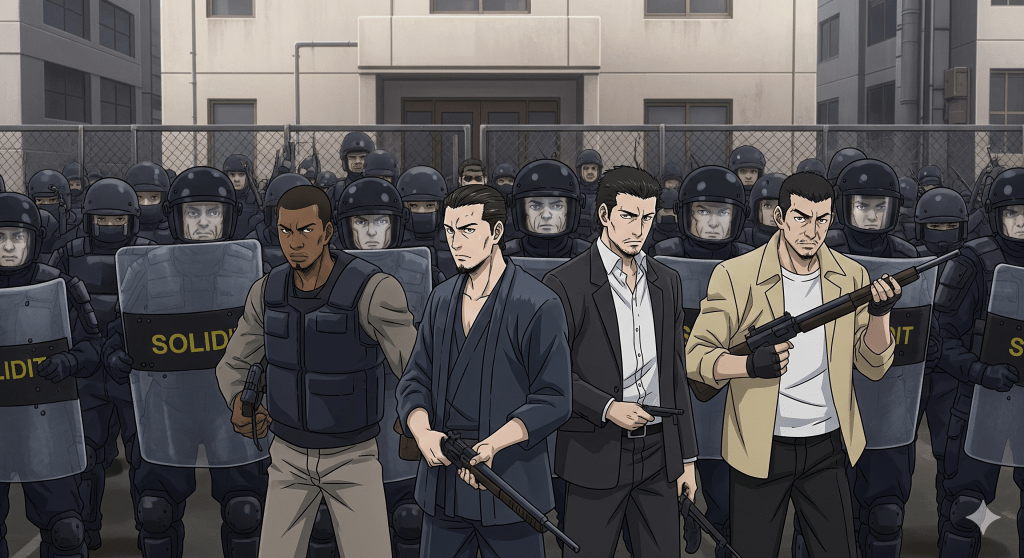
刑事が一人ならまだしも、機動隊まで出てくるなんて、話が違うじゃねえか。
One detective, I could deal with, but the whole riot squad showin’ up? This wasn’t the plan.

This grammar pattern is used to contrast two things, expressing that the first thing (A) might be acceptable or understandable, but the second thing (B) is definitely not acceptable, reasonable, or is going too far.
It’s like sayin’, “A is one thing, I can maybe get with that, but B? Nah, son. That’s a whole other level of wack.” It’s for when you’re drawin’ a line in the sand, sayin’ one thing is maybe acceptable, but the thing that actually happened is straight-up unbelievable or unacceptable. It’s got that flavor of contrast, you feel me? Like Biggie and Tupac, East Coast vs. West Coast – two different worlds.

Here’s the lowdown on how you hook this grammar up.
| Word Type | How to Connect | Example | English Translation |
| Noun | Noun + ならまだしも | 100ドルならまだしも、1000ドルは払えないぜ。 | A hundred bucks, I could maybe swing, but a G? I ain’t payin’ that. |
| Verb (Plain) | Verb + ならまだしも | 失敗するならまだしも、最初からやらないなんて許せない。 | Making a mistake is one thing, but starting from scratch is unacceptable. |
| Adjective | Adj + ならまだしも | ちょっとしたケガならまだしも、入院するなんて大ごとだ。 | A little scratch, fine, but landin’ in the hospital? That’s major. |
So check it, it’s mad simple. You take your noun, your verb in the plain form, or your adjective, and you just slap ならまだしも right on the end of the first part – the part you’re sayin’ is kinda okay. It’s like puttin’ rims on your ride. It just fits. You’re settin’ up the first situation as the “maybe, I guess” option, and then you follow it up with what actually went down, which is usually some next-level nonsense.
Alright, picture this. You’re Henry Hill in Goodfellas. You’re supposed to be makin’ the Sunday gravy with the meatballs and the sausage. Paulie comes in. If you just forgot the garlic, that’s one thing. Forgetting the garlic? Fuggedaboutit, it happens. ニンニクを忘れたならまだしも … Paulie might yell a bit, but you’ll live.
But then, he finds out you used ketchup instead of tomato sauce. Ketchup! In the sauce! That’s a capital offense, you know what I’m sayin’? You don’t do that. That’s the second part of the sentence. The part that’s completely off the rails.
So, ならまだしも is like the garlic. Forgetting it is one level of screw-up. But what comes after is the ketchup – the totally unacceptable, “what were you thinkin’?” situation. It separates a minor hustle from a major bust.
Here are some lines you might hear in the back alleys of Shinjuku.
ナイフならまだしも、銃を持ち出すとは、奴も終わりだな。
A knife is one thing, but pullin’ out a piece? That dude is finished.
見張り役ならまだしも、ヒットマンの仕事は俺には無理だ。
Being a lookout, I can handle, but a hitman job? That ain’t for me.
懲役5年ならまだしも、無期懲役なんて食らったら、人生終わりだ。
Five years in the slammer, I could handle, but if I get a life sentence, my life is over.
多少の賄賂ならまだしも、市長まで買収するなんて、計画がでかすぎる。
A little bribe, okay, but buying the mayor himself? This plan is too big.
警察に追われるならまだしも、国税庁に目をつけられるのは厄介だ。
Being chased by the cops is one thing, but having the National Tax Agency on your tail is a real pain.
事務所へのカチコミならまだしも、親分の自宅を襲撃するとは許せねえ。
Raiding the office is one thing, but attacking the boss’s home? Unforgivable.
密告者が一人ならまだしも、組の半分が裏切っていたとはな。
If it was one rat, okay, but half the family turning traitor…
脅迫状ならまだしも、ボスの娘を誘拐するなんて、奴らは一線を越えた。
A threatening letter is one thing, but kidnapping the boss’s daughter? They’ve crossed a line.
一度の失敗ならまだしも、何度も同じミスを繰り返す奴は信用できねえ。
Failing once is one thing, but a guy who keeps makin’ the same mistake? Can’t trust him.
ちょっとした喧嘩ならまだしも、組同士の戦争になるなんて聞いてないぞ。
A little scuffle, alright, but a full-blown war between families? I didn’t sign up for this.
Aight, that’s the 4-1-1 on ならまだしも. Use it when you gotta make it clear that some things are just not on the same level. Keep it real, stay sharp, and don’t get caught slippin’.

Leave a comment