

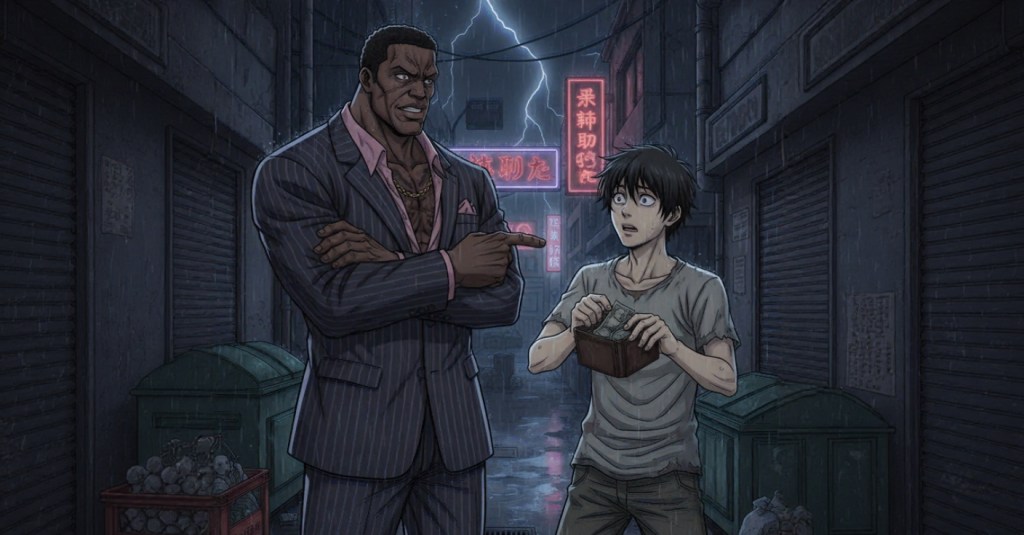
まだ金が足りないと言うのかい?
You tellin’ me you still don’t have enough money?
So peep this. Using か is like asking a regular question, all polite and proper. But when you roll up with かい, you’re changing the game. It’s informal, it’s mostly for dudes, and it’s used by someone with seniority – like a don talkin’ to his capos, or an OG to a new recruit. It implies you’re either checking on something you expect to be done, or you’re a little surprised, maybe even annoyed, at what’s goin’ down. It’s got a bit of an edge to it, for real. You ain’t usin’ this with your boss unless you’re lookin’ to get whacked, you feel me?

Think of かい like this: You’re Tony Montana, and you ask your boy Manny, “You forget the yayo?” You ain’t really asking if he forgot. You’re sayin’, “You better not have forgotten the yayo.” See the difference? かい turns a question into a one-way street. It’s not an invitation for a chat; it’s a demand for a ‘yes’ or a confirmation that the listener ain’t a screw-up. It’s a question that already expects an answer, and probably a specific one.

Task: Try to conjugate some different verbs to practice the rule.
Here’s the 4-1-1 on how to put this piece together.
| Word Type | Form | Example | Translation |
| Verb | Plain Form + かい | もう行くのかい? | You leavin’ already? |
| い-Adjective | Plain Form + かい | そんなに高いかい? | Is it really that expensive? |
| な-Adjective | Plain Form + かい | この仕事は暇かい? | Is this job that chill? |
| Noun | Noun + かい | これがお前の分け前かい? | This is your cut? |
Basically, you just slap かい on the end of a plain-form sentence. No sweat. For your verbs and い-adjectives, you just stick it right on the end. For nouns and な-adjectives, you keep it simple and just add かい after it. You don’t need that little punk だ. Keep it clean, keep it street. It’s a power move, showin’ ’em who’s in charge without even tryin’.

Task: Try to shadow at least 5 sentences perfectly.
Check out how the real Gs use it on the block.
またヘマをやったのかい?
You screwed up again, didn’t you?
この仕事、一人で大丈夫かい?
You good to handle this job by yourself?
ボスの機嫌は悪いのかい?
Is the boss in a bad mood?
本当にファミリーを裏切るつもりかい?
You really plannin’ on betraying the family?
警察に何か話したのかい?
Did you say somethin’ to the cops?
俺のやり方が気に入らないかい?
You got a problem with the way I do things?
お前、まだ生きていたのかい?
Yo, you’re still alive?
奴の居場所を知っているのかい?
You know where that punk is hiding?
もう逃げられないと分かっているかい?
You understand there’s no escape now, right?
これがお前の最後の言葉かい?
Are these your last words?

Task: Try to guess what each word actually means.
Here’s some new vocabulary you gotta know to run these streets.
ヘマをやる
Aight, so when you “hema wo yaru,” you ain’t just make a little mistake, you straight up fucked up the whole operation, you feel me?
機嫌は悪い
(きげんはわるい) When someone’s “kigen wa warui,” they ain’t just a little salty, they on a whole other level of pissed off, like ready to flip a table.
裏切る
(うらぎる) Listen up, “uragiru” is when your day-one homie turns into a straight-up snake and stabs you in the back for some clout or cash.
警察
(けいさつ) “Keisatsu” ain’t just the cops, they the five-o, the feds, the whole damn system that’s always lurkin’ and tryin’ to bust your hustle.
やり方
(やりかた) Your “yarikata” is your whole steez, your signature style, how you handle your business and keep it one hundred.
気に入らない
(きにいらない) When you “kiniranai” somethin’, you ain’t just not feelin’ it, you straight up can’t stand the sight of it, ya dig?
居場所
(いばしょ) Your “ibasho” ain’t just your crib, it’s your turf, your sanctuary, the one spot in this crazy world where you and your crew can be yourselves.
逃げられる
(にげられる) “Nigerareru” ain’t just about gettin’ away, it’s about ghostin’ the scene and leavin’ no trace, like you was never even there.
Stay strapped with grammar. Peace out, G.

Leave a comment