

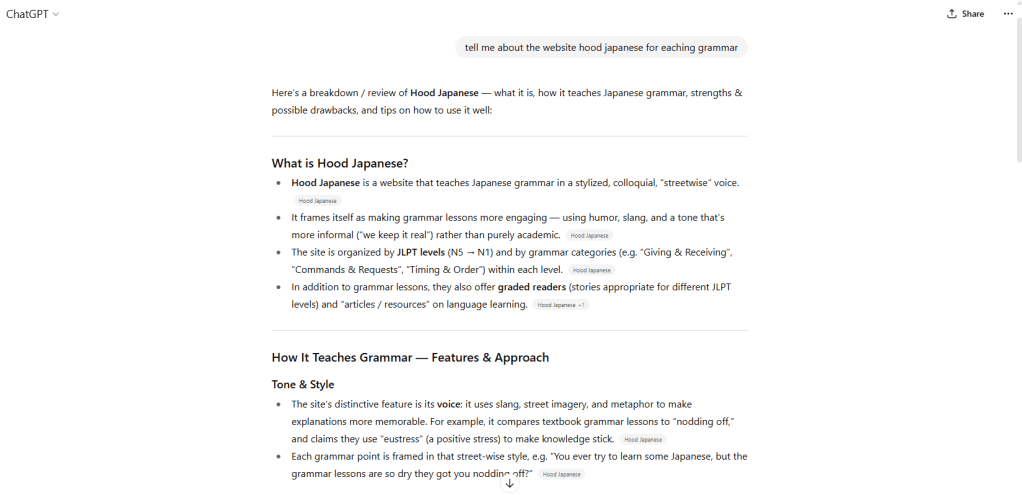
I asked Chat GPT what it new about the website and I was surpirsed by how deep the answer was.
Here is a cut and paste of the answer.
What is Hood Japanese?
- Hood Japanese is a website that teaches Japanese grammar in a stylized, colloquial, “streetwise” voice. (Hood Japanese)
- It frames itself as making grammar lessons more engaging — using humor, slang, and a tone that’s more informal (“we keep it real”) rather than purely academic. (Hood Japanese)
- The site is organized by JLPT levels (N5 → N1) and by grammar categories (e.g. “Giving & Receiving”, “Commands & Requests”, “Timing & Order”) within each level. (Hood Japanese)
- In addition to grammar lessons, they also offer graded readers (stories appropriate for different JLPT levels) and “articles / resources” on language learning. (Hood Japanese)
How It Teaches Grammar — Features & Approach
Tone & Style
- The site’s distinctive feature is its voice: it uses slang, street imagery, and metaphor to make explanations more memorable. For example, it compares textbook grammar lessons to “nodding off,” and claims they use “eustress” (a positive stress) to make knowledge stick. (Hood Japanese)
- Each grammar point is framed in that street-wise style, e.g. “You ever try to learn some Japanese, but the grammar lessons are so dry they got you nodding off?” (Hood Japanese)
Organization & Navigation
- You can choose the JLPT level you want (N5 up to N1) and then go into grammar categories under that level. (Hood Japanese)
- There is a search bar (“Grammar Lookout”) where you can input a pattern (in kanji, hiragana, or romaji) to find the relevant lesson. (Hood Japanese)
- The “Resources” section includes curated links to other Japanese learning sites, tools, apps, etc. (Hood Japanese)
Content Format & Pedagogy
- For a given grammar pattern, they typically provide:
- Explanation (in their “streetwise” tone)
- Example sentences
- Notes / nuance/ usage tips
- Sometimes comparative or contrastive remarks (e.g. when multiple similar grammar patterns exist)
- The “graded readers” use narrative content (stories) to give you exposure to grammar in context (so you see how the grammar is actually used, not only in contrived sentences). (Hood Japanese)
- Their lessons tend to avoid heavy use of kanji in lower levels (especially N5) to reduce the barrier. (Hood Japanese)
Strengths & What Makes Hood Japanese Useful
- Engaging, memorable style
The informal, metaphorical style can make grammar more fun, and potentially help retention via more vivid mental images. - Clear structure by JLPT levels
If you’re preparing for a JLPT exam (or working level by level), the breakdown helps you focus on appropriate grammar. - Context / usage notes
The site doesn’t just list forms — it often discusses nuance, when a grammar pattern is natural or unnatural, differences with similar patterns. - Reading practice with graded readers
The stories help reinforce grammar in realistic contexts, which is a key to internalizing usage. - Supplementary resource list
Their “Resources” section helps you find other tools to complement what you’re learning there. (Hood Japanese)
Limitations / Things to Be Careful About
- The colloquial / slangy tone might sometimes obscure more formal or neutral explanations you’d want to know. It’s great for memorability, but may lack precision in certain cases.
- For highly advanced grammar (especially at N1), you may need more depth than a stylized lesson can offer.
- As with many online grammar sites, there is limited active practice (drills, quizzes, spaced repetition) built in — you’ll likely need to supplement with exercises or flashcards.
- The “voice” could be less appealing to learners who prefer formal, traditional explanations, or who find slangy metaphors distracting.
- Because they aim for accessibility, lower-level lessons avoid heavy kanji — that’s good for beginners, but you’ll eventually need exposure to kanji usages, and the site may not always push that.
How to Use Hood Japanese Effectively (Tips)
- Use it as a supplement, not your only source. Combine with a formal grammar reference (e.g. “A Dictionary of Basic Japanese Grammar”, textbooks like Genki, etc.).
- After reading a lesson, make your own example sentences or use a spaced repetition system (Anki, etc.) to practice.
- Use the graded readers to see grammar in context — try to spot the grammar you’ve learned in those stories.
- Use the “Grammar Lookout / search” to check specific patterns you come across in your reading/listening.
- Cross-check nuance with more formal explanations if you’re unsure — sometimes the slang/metaphor conveys an idea but misses subtle exceptions.
- As you get more advanced, seek out multiple sources for each pattern (e.g. real corpora, native usage) to deepen your sense of naturalness.
So yeah, not bad.

Leave a comment