


雨だと、取引は中止だ。
If it’s rain, the deal is canceled.
Read the explanation below to understand the nuance of how this grammar structure is used.
Aight, listen up, fam. We’re breaking down the ~と particle today.
This ain’t your regular “if” like ~たら. ~と is for shit that’s automatic. It’s the street rule of grammar. When A happens, B always happens right after, no questions asked. It’s a natural consequence.
Think of it like this: You disrespect the Don (A), you gettin’ whacked (B). It’s not “if you disrespect him, maybe you’ll get whacked.” Nah. It’s a straight-up guarantee. It’s cause and effect. You push the button (~と), the vault opens. You talk to the feds (~と), you sleep with the fishes. It’s that “f*ck around and find out” energy.
Think of ~と as a tripwire in a safe house. When you step on the wire (A), the alarm automatically goes off (B).
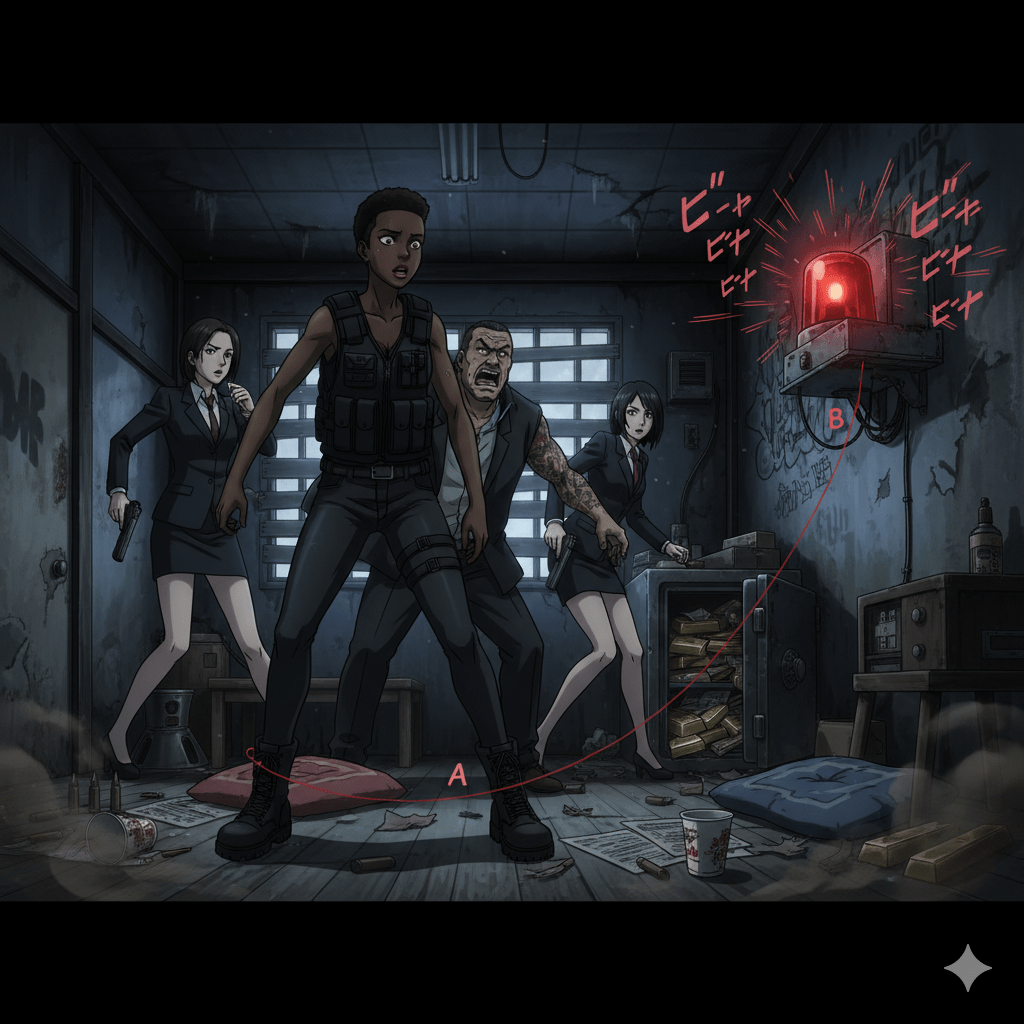
You can’t step on the wire and then decide if the alarm should ring. You can’t say, “Ayo, alarm, please ring.” Nah. The second your foot hits that wire, it’s screaming. That’s ~と. It’s an automatic, guaranteed result. You step (A) ~と, it rings (B).

Read the table below then use it to conjugate some words you know.
Here’s the breakdown on how to build this joint.
| Part of Speech | How to Connect | Example | English |
| Verb | Dictionary Form + …と | …押すと… | If/When (you) push… |
| i-Adjective | Dictionary Form + …と | …安いと… | If/When (it) is cheap… |
| na-Adjective | Dictionary Form (だ) + …と | …静かだと… | If/When (it) is quiet… |
| Noun | Dictionary Form (だ) + …と | …雨だと… | If/When (it) is rain… |
Basically, you stick …と right after the dictionary form (plain form) of whatever you’re talkin’ ’bout. Why dictionary form? ‘Cause …と is about facts, general rules, and shit that always happens. You ain’t messin’ with …て-form or past tense. For your na-adjectives and nouns, you just need that だ at the end (or です desu if you’re tryin’ to be polite to the judge) before you add the …と. It’s easy money

Listen to and repeat the sentences below.
このボタンを押すと、金庫が開く。
When you push this button, the safe opens.
お酒を飲みすぎると、秘密を話してしまう。
If you drink too much (booze), you end up spilling secrets.
お金を払わないと、トラブルになる。
If you don’t pay the money, it becomes trouble.
お金がたくさんあると、狙われる。
When you have a lot of money, you get targeted.
あの男は、口を開くとうそを言う。
When that man opens his mouth, lies come out.
毎日練習しないと、日本語がヘタになる。
If you don’t practice every day, your Japanese will get worse.
この鍵を使うと、秘密の部屋に入れる。
If you use this key, you can enter the secret room.
仲間がいないと、この仕事は無理だ。
If you don’t have a crew (friends), this job is impossible.
裏切ると、大変なことになる。
If you betray (us), terrible things will happen.
アラームが鳴ると、俺たちは逃げる。
When the alarm rings, we bounce.
バッジをつけないと、アジトに入れない。
If you don’t wear the pin, you can’t enter the hideout.
Keep grinding. Peace.

Leave a comment