

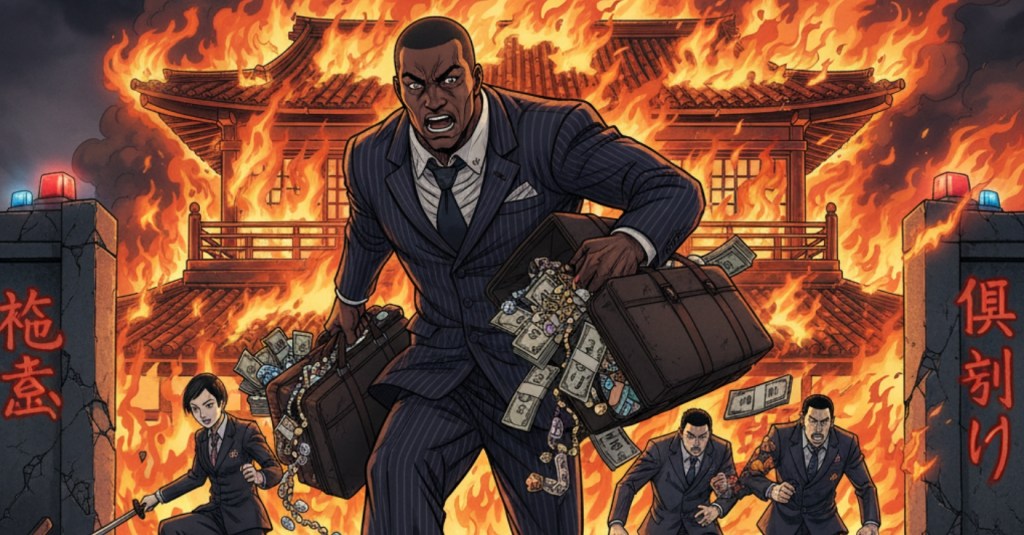
火事の場合は、まず現金と宝石を運べ。
In case of fire, move the cash and jewels first.

Read the explanation below to understand the nuance of how this grammar structure is used.
Yo, straight up, ~場合は (baai wa) means “in the event of” or “in case…”
This ain’t your simple “if” like ~たら which is just like, “If I see him, I’ll tell him.” Whatever.
~場合は is more serious. It’s about a specific situation or contingency. You’re setting up a rule or a plan for a problem that might happen. It’s like when the boss says, “In case our enamies makes a move, you know what to do.” You’re preparin’ for a specific scenario, usually one that needs a specific response. It’s more formal, more official. It’s the “just in case” clause in your street contract.
You use this joint when you’re layin’ down the law or givin’ serious instructions. Think about the rules of the hustle. It’s all about preparation and consequences. You see it on signs, in rulebooks, and when your boss is tellin’ you the plan so you don’t screw it up

Using this with present tense and past tense can get a little tricky though, because in English we usually just keep everying in present tense. It’s a small change, but it’s all about timing. Pay attention.
The Breakdown: suru vs. shita
Straight up, the difference is about whether the action is done or not yet.
- Dictionary Form + ~場合は (e.g.,
する場合は–suru baai wa) This is for a potential situation. The action hasn’t happened yet, or it’s a general rule. You use this when you’re talking about “In the event you are going to…” or “In case you find yourself…” It’s the plan before or during the event. It’s still a hypothetical. - Past Tense (た-form) + ~場合は (e.g.,
した場合は–shita baai wa) This is for after the action is complete. You’re talkin’ about the result. The thing has already happened, and now you’re sayin’ what to do. It’s the “In the event that you have already…” or “Now that you’ve done…” scenario. It’s the aftermath.
Think about it like this. You owe some money, right?

- Dictionary Form (
遅れる場合–okureru baai wa): This is you, before the due date, thinkin’ ahead. “In the event I’m going to be late (okureru baai wa) with the cash, I’ll call the boss in advance.” The lateness hasn’t happened, but you see it comin’. It’s a potential problem. - Past Tense (
遅れた場合–okureta baai wa): This is the boss layin’ down the law. “In the event you were late (okureta baai wa) — meaning the due date passed and you messed up — the interest doubles.” The action (being late) is done. It’s a completed fact, and now there’s a consequence.
Most of the time, especially when givin’ instructions for emergencies (like “if you get caught,” “if you lose the money”), you’ll use the Past Tense (た-form). Why? Because you’re giving the instruction for after the bad thing has already happened.

Read the table below then use it to conjugate some words you know.
Here’s how you hook this grammar up. It’s dead simple.
| Type | How to Connect | Example | English |
| Verb (Plain) | Dictionary Form + 場合は | 失敗する 場合は | In the event you fail… |
| Verb (Past) | Past Tense (た-form) + 場合は | 失敗した 場合は | In the event you failed… |
| い-Adjective | い-Adjective + 場合は | 危ない 場合は | In the event it’s dangerous… |
| な-Adjective | な-Adjective + な + 場合は | 危険な 場合は | In the event it’s dangerous… |
| Noun | Noun + の + 場合は | 警察の 場合は | In the case of the police… |
Look, it ain’t complicated. You’re just connecting this phrase to the condition. For verbs, you stick it right on the plain form (like iku) or the plain past (like itta). For Nouns, you gotta put that の (no) in between, like you’re showin’ possession. For な-adjectives, don’t you dare forget the な (na). For い-adjectives, just mash ’em together. You’re just setting up the specific scenario before you say what action to take.

Listen to and repeat the sentences below.
弾がない場合は、素手で戦うしかない。
If you have no bullets, you just gotta fight with your bare hands.
怪しい人がいる場合は、すぐに知らせてください。
If there’s a suspicious person, please inform us at once.
目撃者がいる場合は、口止め料を払え。
If there’s a witness, pay the hush money.
支払いが遅れた場合は、利息が3倍になるぞ。
If the payment is late, the interest triples, ya hear?
助けが必要な場合は、この赤いボタンを押せ。
In the event you need help, push this red button.
拳銃が壊れた場合は、ナイフを使え。
In case your gun doesn’t work, use a knife.
金庫の番号を忘れた場合は、ボスに殴られるぞ。
If you forget the safe combination, you’re gonna get punched by the boss.
取引が失敗した場合は、すぐに連絡してくれ。
If the deal fails, contact me right away.
スパイを見つけた場合は、静かに処理しろ。
In the event you find the snitch, “handle” him quietly.
捕まった場合は、何も話すな。
In case you get caught, don’t say anything.
Class dismissed.

Leave a comment