

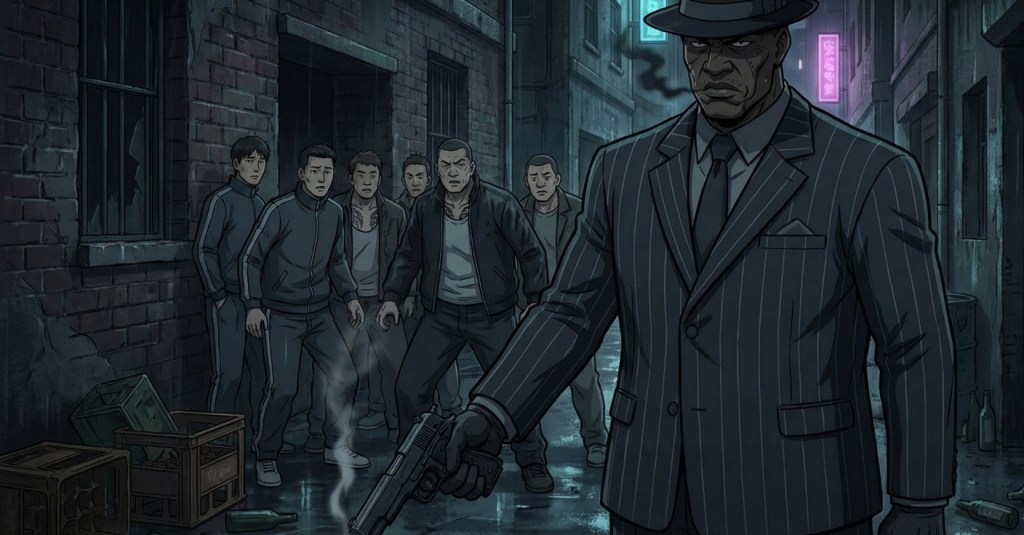
静まらざる怒りを抑えて、彼は静かに引き金を引いた。 Holding back his “unquellable” anger, he calmly pulled the trigger.

Read the explanation below to understand the nuance of how this grammar structure is used.
The grammar point ざる is the classical version of ない. In the N2 level, you usually see it in the form ~ざるを得ない (zaru o enai), which means you “can’t help but do something” or you “got no choice.” It’s stiff, it’s formal, and it carries weight. Using ざる is like wearing a tailored suit to a court date—it shows you mean business. It’s got a literary, almost “Old Testament” vibe. When you use it, you aren’t just saying “no,” you’re making a declaration.
The Metaphor: The “Omertà” of Grammar
Think of ざる like the Code of Silence. In the streets, “Omertà” isn’t just a suggestion; it’s an ancient, unbreakable law. ざる is the same way. It’s the “Old Head” of Japanese grammar. It’s not modern, it’s not flashy, but it’s got that “OG” respect. When you use it, it’s like you’re quoting the bylaws of a powerful organization. It turns a simple “don’t” into a “thou shalt not.”

Read the table below then use it to conjugate some words you know.
Check the chart below to see how we flip these verbs into that rugged classical form.
| Verb Type | Dictionary Form | Conjugation (Nai-stem + ざる) | English Translation |
| Group 1 | 話す | 話さざる | Not speaking |
| Group 2 | 食べる | 食べざる | Not eating |
| Group 3 | 来る | 来ざる | Not coming |
| Irregular | する | せざる | Not doing |
To get this right, you take the Nai-form of the verb but drop the ない and slap on ざる. It’s mostly the same as your standard negative stem, but Group 3 is a bit trippy. する becomes せざる, not “shizaru.” Don’t trip on that, or you’ll look like a rookie on his first day in the yard. It’s all about that stem, then adding the ざる to make it an adjective describing the person or situation coming next.

Read and master the example sentences below.
知らざる他人のために命を張るほど、俺は お人好しじゃない。
I ain’t nice enough to risk my life for some stranger I don’t know.
銃を持たざる者は、この路地裏を通るべきではない。
Those who don’t pack heat shouldn’t be walking through this alley.
働かざる者は、組の飯を食う資格はない。
Those who don’t work don’t have the right to eat the clan’s food.
この街には、絶えざる銃声が子守唄のように響く。
In this town, “ceaseless” gunfire rings out like a damn lullaby.
許されざる不倫の末に、彼はコンクリート詰めにされた。
After an “unforgivable” affair, he ended up inside a block of concrete.
知らざる他人に、自分のバッグを預けるほどバカじゃない。
I ain’t stupid enough to trust an “unknown” stranger with my bag.
成し遂げざる野心を抱いたまま、彼は刑務所で果てた。
He died in the joint still holding onto his “unfulfilled” ambition.
望まざる再会が、路地裏で突然やってきた。
An “unwanted” reunion happened suddenly in a back alley.
果たせざる約束など、最初からするな。
Don’t go making “unkeepable” promises in the first place.
眠らざる街、新宿の闇には悪党がよく似合う。
Villains look good in the darkness of the “sleepless” city, Shinjuku.
Stay dangerous.

Leave a comment