

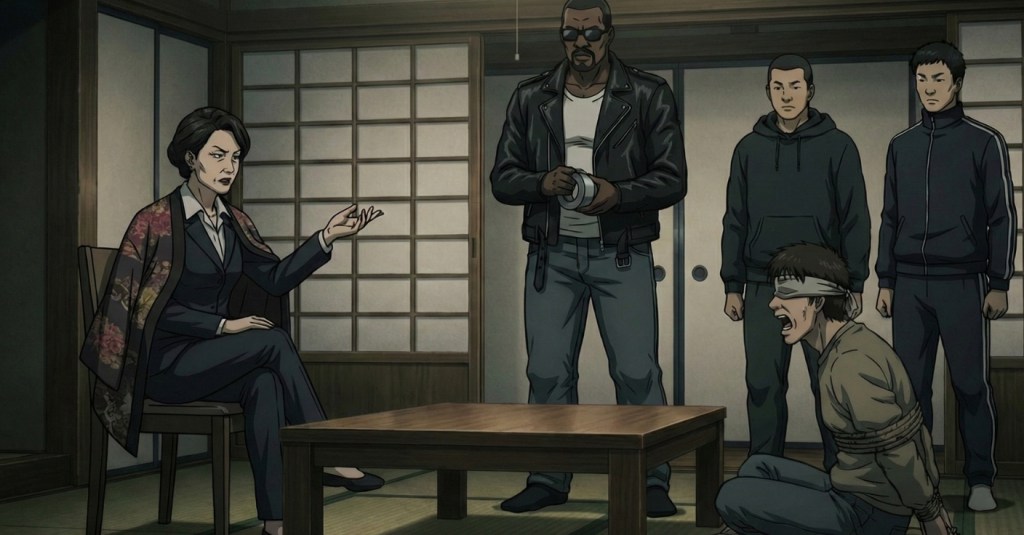
彼の口をテープで塞いで頂戴。
Tape that guy’s mouth shut for me.

Read the explanation below to understand the nuance of how this grammar structure is used.
The Lowdown on the Nuance
In the streets of Tokyo, ~て頂戴 (te choudai) is basically the casual, slightly “bossy” cousin of ~te kudasai. It’s a way to ask someone to do something, but it carries a specific vibe. Historically, it’s associated with feminine speech or mothers telling their kids what to do.
Think of it like Alonzo Harris in Training Day. He doesn’t always have to yell; sometimes he just tells you to do something with that smooth, terrifying confidence. When you use ~て頂戴, you’re making a request, but you’re expecting it to get done. It’s “polite” on the surface, but underneath, there’s no room for “no.”
When to Use This Hustle
You use this when you’re talking to someone “below” you in the hierarchy, or when you’re being cheeky with a homie. If you’re the Don of the family and you want your nephew to go grab some cannoli (or some karaage), you hit him with the ~て頂戴. It’s perfect for situations where you want to sound sophisticated but still let ’em know who’s holding the keys to the kingdom.
The Metaphor
Using ~て頂戴 is like wearing a velvet glove over a brass knuckle. The “velvet” is the polite-sounding request, making it seem like you’re being nice. But the “brass knuckle” is the underlying authority that says, “If this doesn’t happen, we’re gonna have a problem.” It’s the grammar equivalent of a mob boss saying, “Do me a favor,” while his bodyguards are standing right behind him.

Check the chart below to see how we flip the script on these verbs.
| Verb Type | Dictionary Form | Te-form + 頂戴 | English Translation |
| Group 1 | 書く | 書いて頂戴。 | Write it down for me. |
| Group 2 | 食べる | 食べて頂戴。 | Eat it up. |
| Irregular | する | して頂戴。 | Do it for me. |
| Irregular | 来る | 来て頂戴。 | Come over here. |
To get this right, you just take the Te-form of any verb and slap 頂戴 (choudai) on the end. If you want to be even more casual, you can drop the “頂” and just say “ちょうだい” in hiragana. It’s like shortening “Information” to “the 411.” It makes the request feel smoother and less like a formal contract.

Read and master the example sentences below.
最後に言い残したことを言って頂戴。
Say your last words for me.
隠し場所を教えて頂戴。
Tell me where the stash is hidden.
血がついたシャツを洗って頂戴。
Wash this blood-stained shirt for me.
監視カメラを壊して頂戴。
Smash the security cameras for me.
毒味をして頂戴、この寿司怪しいから。
Taste-test this for poison, this sushi looks sus.
私の代わりに刑務所に行って頂戴。
Go to prison in my place, would ya?
その銃をしまって頂戴、危ないから。
Put that piece away, it’s dangerous.
この手紙を組長に届けて頂戴。
Deliver this letter to the big boss.
私の靴を磨いて頂戴。
Shine my shoes for me.
証拠を全部燃やして頂戴。
Burn all the evidence for me.
Stay dangerous.

Leave a comment