

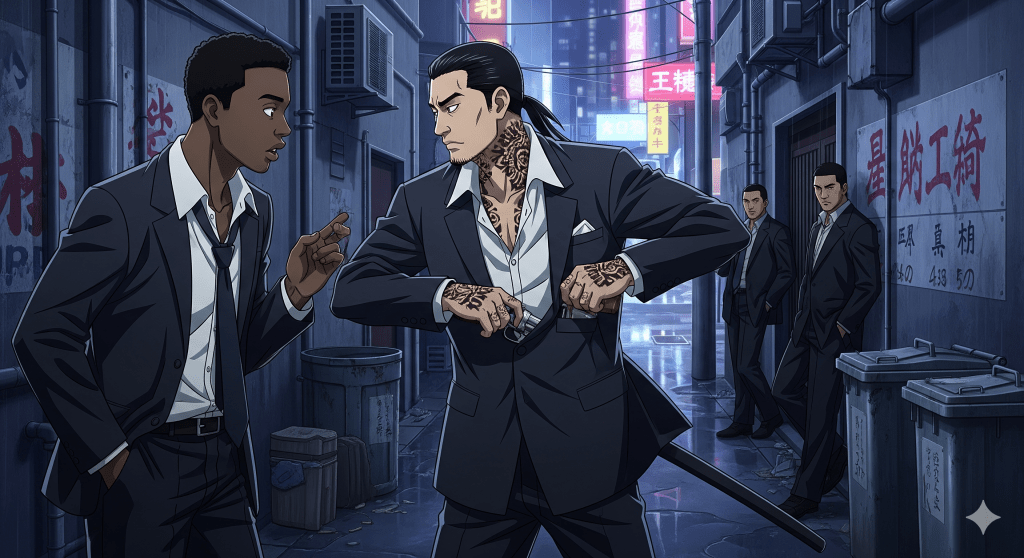
どんな ぶき を つかいます か。
Donna buki o tsukaimasu ka.
What kind of weapons do you use?
So, check it. どんな is like the ultimate question tag when you wanna know what somethin’ is like. It ain’t just askin’ “what.” It’s askin’ “what kind of?” or “what sort of?” It’s a qualifier, know what I’m sayin’? You use it when you’re tryna get the lowdown on the quality, the characteristics, the whole vibe of a person, place, or thing.
It’s like when you see some cats rollin’ up in a new ride. You don’t just say, “what car?” You’d be like, “Yo, what kinda car is that?” You wanna know if it’s a sleek Caddy or a busted-up Honda Civic. どんな is for gettin’ that specific info. It’s the difference between asking “who is he?” and “what kinda dude is he?”
You never see this word just hangin’ out by itself, either. It always gotta be followed by a noun. It’s like a gangster and his crew—they roll together. You can’t have どんな without a noun right behind it.
This one is a piece of cake, so listen up. どんな ain’t a verb or an adjective, so it don’t get all twisted up. It’s just a straight-up question word that modifies a noun.
| Grammar Pattern | How to Use It |
| どんな + Noun | Put どんな right before the noun you wanna ask about. |
Think of どんな like a detective’s magnifying glass. You ain’t just lookin’ at the crime scene; you’re gettin’ in close, checkin’ for clues, tryna figure out the specifics. It helps you paint a picture of what went down. When you use どんな, you’re the detective, and you’re tryna get the real facts, not just the surface-level stuff.
Here are five words to help you navigate the underworld of these sentences.
カシラ (Kashira)
English: The boss; the head honcho.
This is the big homie, the one who runs the whole operation. The one who makes the calls, gets the respect, and gets the final say. He’s the man in charge, the top dog.
タマ (Tama)
English: The target; the mark.
This is the person or thing you’re after. The target of your scheme, the person you need to get to. If you’re plannin’ a heist, the jewels are the “tama.” If you’re plannin’ a beatdown, the cat you’re goin’ after is the “tama.”
シマ (Shima)
English: Territory; turf.
This is your block, your neighborhood, your area of control. It’s where you and your crew run things. Messin’ with someone’s “shima” is a major no-no and will get you into a whole lotta trouble.
メンツ (Mentsu)
English: Crew; gang; the fam.
This is your ride-or-die team. The people you do business with, the ones who got your back no matter what. It’s more than just friends; it’s a brotherhood, a family.
ショバ (Shoba)
English: The scene; the place of business.
This is where the action goes down. The hideout, the warehouse, the street corner where you make your deals. It’s the spot where you do your dirty work.
Aight, let’s put this lingo to the test. These sentences are straight outta the hood, so read ’em, learn ’em, and don’t get caught slippin’.
カシラ は どんな おとこ が すき ですか。
Kashira wa don’na otoko ga suki desu ka?
What kind of man does the boss like?
これ は どんな ショバ ですか。
Kore wa don’na shoba desu ka?
What kind of place is this?
てき は どんな めんつ と くんで いますか。
Teki wa don’na mentsu to kunde imasu ka?
What kind of crew is the enemy teamed up with?
どんな しま を ねらって いますか。
Don’na shima o neratte imasu ka?
What kind of territory are you targeting?
あの たま は どんな じょうほう を もって いますか。
Ano tama wa don’na jōhō o motte imasu ka?
What kind of information does that target have?
どんな やつ を しめれ ば いい ですか。
Don’na yatsu o shimereba ii desu ka?
What kind of guy should I beat up?
どんな ぶき を つかいますか。
Don’na buki o tsukaimasu ka?
What kind of weapon are you gonna use?
くみちょう は どんな かお を して いますか。
Kumichō wa don’na kao o shite imasu ka?
What kind of face does the gang leader have?
どんな にげみち が ありますか。
Don’na nigemichi ga arimasu ka?
What kind of escape route is there?
どんな うらぎりもの が いるか おしえて。
Don’na uragirimono ga iru ka oshiete.
Tell me what kind of traitor there is.
Alright, that’s the word. Holla at your boy if you got more questions. Peace.

Leave a comment