

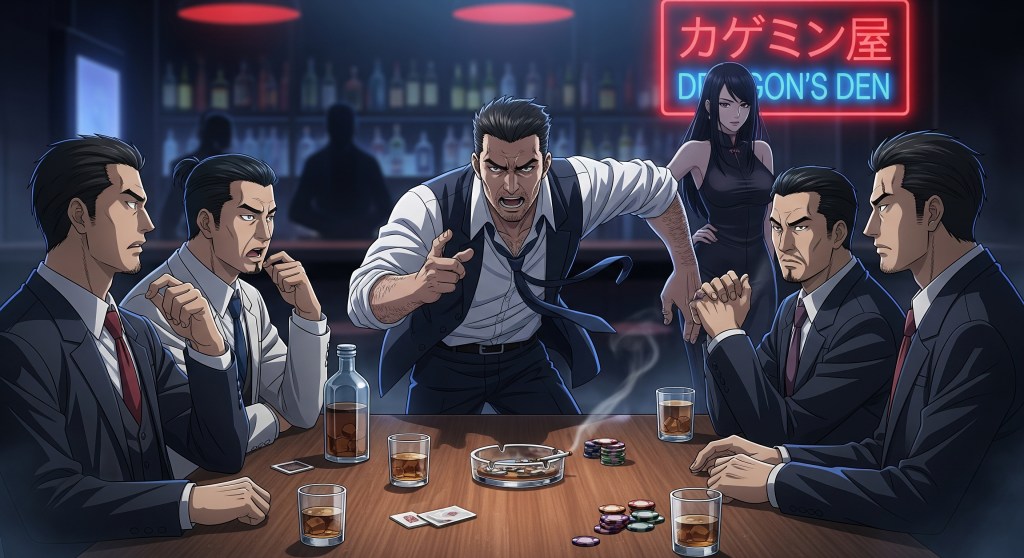
あのおんなは うそつきだと おもう。
ano onna wa usotsuki da to omou.
I think that woman is a liar.
This right here is how you express a thought, a belief, or an opinion. It’s like sayin’, “I think that…” or “I believe that…” in English. It’s the way you put your two cents in without soundin’ like a know-it-all. You ain’t declarin’ a fact; you’re just throwin’ your thoughts out there for the squad to consider. It lets the other cats in on what you’re ponderin’, what you’re feelin’. It’s smooth, respectful, and keeps the conversation flowin’.
This table shows you how to put the pieces together, no funny business.
| Type | Form | English Translation | Hiragana |
| Verb | Plain Form + とおもう | to think (that) | とおもう |
| い-Adjective | い-Adjective + とおもう | to think (that) it is | とおもう |
| な-Adjective | な-Adjective + だ + とおもう | to think (that) it is | だとおもう |
| Noun | Noun + だ + とおもう | to think (that) it is | だとおもう |
You see how it works? Just grab that plain, no-frills form of the verb, adjective, or noun, and slam と (to) and おもう (omou) right after it. Don’t be gettin’ all fancy with your polite forms here. We keep it real. For the な-adjectives and nouns, you gotta throw in a little だ (da) right before the と (to). Think of it like a secret handshake to connect the pieces. It’s the raw, uncut version of the language.
Think of it like this: your brain is a trap house, right? And ~とおもう is the front door. You use it to let the world know what kind of product you’re cookin’ up inside. You ain’t just pushin’ a brick of truth on ’em; you’re showin’ ’em a sample, lettin’ ’em know what you believe to be the real deal. It’s a way of sayin’, “From where I’m standin’, this is how I see things playin’ out.”
Here are some terms to help you stay on point in these concrete jungles.
いんたいする (Intai suru)
English: To retire.
When you talkin’ ’bout retiring, you talkin’ ’bout a real boss move. That’s when a cat been in the game for a minute, made his paper, and decides to step back from the hustle. Like, he ain’t got to hit the streets no more ’cause he already stacked his chips. Think of it like when a heavyweight champ hangs up his gloves. It’s a sign of a real G who made it out the paint.
きけん (Kiken)
English: Danger
This word, kiken, is what you feel when you know somethin’ is shady, somethin’ ain’t right. It’s the vibe you get before you step into a sketchy spot or when you see a rival crew rollin’ up on your block. It’s that feeling that tells you to stay alert, keep your eyes open, and watch your back ’cause trouble is around the corner. It’s the opposite of chill.
ふくざつ (Fukuzatsu)
English: Complicated.
Man, when you say somethin’ is fukuzatsu, you’re sayin’ it’s a hot mess. It’s like tryin’ to untangle a hundred different phone cords after they been mashed up in a box. It ain’t simple. It’s got too many pieces, too many sides to it. Like a deal that has way too many rules and clauses, or a situation with a lot of different people and problems all mixed up. It’s a headache.
にせもの (Nisemono)
English: Fake; forgery; impostor.
A nisemono is a fraud, a phony, a straight-up imposter. This is the cat that frontin’ like he’s the real deal but ain’t got the stripes to prove it. He’s wearin’ knock-off gear, talkin’ like he’s a big shot, but everyone knows he’s a joker. It’s like a fake ID—it looks real on the surface, but it ain’t got no power. It ain’t authentic.
せいこうする (Seikou suru)
English: To succeed.
To succeed, or seikō suru, is to get that win. It’s to make it, to come out on top. This is when your plan pays off, when the hustle works, and you get that paper. It’s when you go from nothin’ to somethin’. Like when a rapper goes from battlin’ on the streets to sellin’ out arenas. It’s the ultimate goal, the top of the mountain.
Here are a few sentences to help you get the hang of it.
このじゅうは にせものだと おもう。
kono juu wa nisemono da to omou.
I think this gun is a fake.
あいつは おれのかねを ぬすんだと おもう。
aitsu wa ore no kane o nusunda to omou.
I think that guy stole my money.
このしごとは きけんだと おもう。
kono shigoto wa kikenda to omou.
I think this job is dangerous.
あのくるまは てきの くるまだと おもう。
ano kuruma wa teki no kuruma da to omou.
I think that car is the enemy’s car.
この しまは もう おれたちの ものだと おもう。
kono shima wa mou oretachi no mono da to omou.
I think this territory is already ours.
あのやくざは もう いんたいしたいと おもう。
ano yakuza wa mou intai shitai to omou.
I think that yakuza wants to retire already.
あしたは けいさつが こないと おもう。
ashita wa keisatsu ga konai to omou.
I think the cops won’t come tomorrow.
かれは しゃっきんが はらえないと おもう。
kare wa shakkin ga haraenai to omou.
I think he can’t pay his debt.
おれたちの ビジネスは せいこうすると おもう。
oretachi no bijinesu wa seikou suru to omou.
I think our business will succeed.
このはなしは もっと ふくざつだと おもう。
kono hanashi wa motto fukuzatsu da to omou.
I think this situation is more complicated.
Stay strapped with that knowledge. Catch you on the flip side. Peace.


Leave a comment