

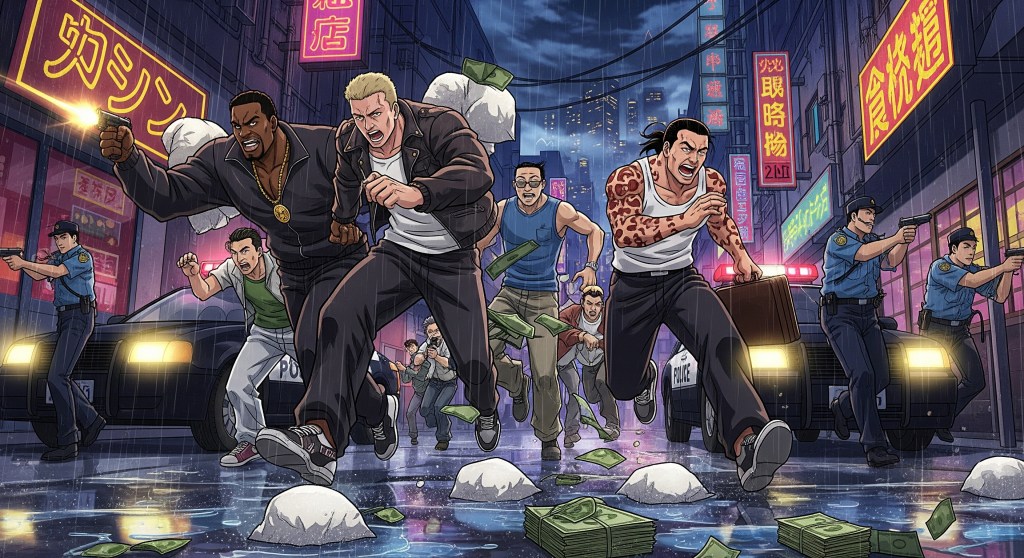
やく の とりひき は うまく いかなかった。
Yaku no torihiki wa umaku ikanakatta.
The drug deal didn’t go well.
Today we’re gettin’ down with some real talk about the past. We’re talkin’ about the なかった (nakatta) form, but this time we’re keepin’ it strictly with the verbs. This ain’t just some regular grammar, nah. This is the plain past negative form. It’s how you tell your crew something didn’t happen back then. It’s the opposite of the plain past affirmative, the た-form. When you’re tellin’ a story, spillin’ the tea on why you couldn’t make it to the drop, or how the plan went south, this is the grammar you reach for. It’s raw, it’s real, and it’s straight to the point. No need for that fancy polite talk.
This is how you get your verbs to fall in line and use the なかった form.
| Type | Conjugation | Example |
|---|---|---|
| Verbs | Drop the final い from the ない form and add なかった. | いく iku I go いかない ikanai I don’t go いかなかった ikanakatta I didn’t go |
When you’re dealing with verbs, you gotta get rid of the final -i from the negative form, and then you just slap on -nakatta. It’s the same flow whether it’s a regular verb or a street-smart irregular like する (suru) or くる (kuru)
Imagine you’re rollin’ up on a deal, and the other crew’s boss says, “Where’s the goods?” You point to the trunk of your ride, but you can’t open it. You mess with the lock, try to jimmy it, but it’s no use. The trunk didn’t open. The key wasn’t with me. That’s the なかった (nakatta) form, right there. It’s about a locked door, a missed opportunity, a failure to come through. It’s what you say when the plan didn’t go down the way it was supposed to, and you gotta explain why. It’s the grammar of a botched job or a cold-blooded alibi.
Peep these words before you hit the examples.
て を だす (Te o dasu)
English: To put your hands on someone; to get physical with someone.
Yo, this one’s all about keepin’ it real with your hands. When someone’s actin’ up and you gotta put ’em in their place, you put your hands on ’em. But it ain’t always about violence. It can also mean you’re gettin’ involved in somethin’ or helpin’ someone out. It’s about gettin’ in the mix.
けいい を はらう (Keii o harau)
English: To pay respects; to show respect.
You gotta know who runs things, right? This phrase is all about showin’ mad respect to the OG, the shot-caller, the big homie. It’s a sign of loyalty and acknowledgement, like when you nod your head to a real one on the block. You gotta pay your respects to those who came before you.
ぜ (Ze)
English: A particle used at the end of a sentence to show emphasis or a declaration.
This ain’t really a word on its own, it’s more like a vibe. You slap this on the end of a sentence when you’re tryna get a point across, you feel me? It’s like sayin’, “for real,” or “straight up.” Like, “I’m the man, ze!” It adds some muscle to what you’re sayin’.
てっぽうだま (Teppoudama)
English: A hired gun; an enforcer.
Every crew needs a soldier, a dude who ain’t afraid to get his hands dirty. A dude you can call when you need somethin’ handled, no questions asked. That’s a hired gun, an enforcer. This word is what you call that soldier, that dude who’s a straight-up killer for the crew. Think about it like Marlo Stanfield’s enforcer on “The Wire.” That’s who this word is for.
しゅうかい (Shuukai)
English: A meeting; a gathering.
This is when the whole crew links up. You call a meeting to get everybody on the same page, to talk business, or to lay down the plan for the next hustle. It’s a closed-door thing, where only the real ones get to step inside. Everybody gotta be there to get the message straight.
Aight, listen up. Here’s a list of examples so you can see how to use this grammar in a real way.
おまえ の くるま は きのう から そこ に いなかった ぜ。
Omae no kuruma wa kinou kara soko ni inakatta ze.
Your car wasn’t there since yesterday.
てっぽうだま の やつ は でんわ に でなかった。
Teppoudama no yatsu wa denwa ni denakatta.
The foot soldier didn’t answer the phone.
あいつ は おやぶん に けいい を はらわなかった。
Aitsu wa oyabun ni keii o harawanakatta.
He didn’t show respect to the boss.
あの かたぎ は なにも みなかった らしい。
Ano katagi wa nanimo minakatta rashii.
That civilian didn’t see anything, apparently.
やくそく の じかん に だれも こなかった。
Yakusoku no jikan ni daremo konakatta.
Nobody came at the promised time.
あたらしい しのぎ は だれも しらなかった。
Atarashii shinogi wa daremo shiranakatta.
Nobody knew about the new hustle.
やつ は ぜったい に て を ださなかった。
Yatsu wa zettai ni te o dasanakatta.
He absolutely didn’t lay a hand on him.
きのう は くみ の しゅうかい に いかなかった。
Kinou wa kumi no shuukai ni ikanakatta.
I didn’t go to the gang meeting yesterday.
おれたち の けいかく は しっぱい しなかった。
Oretachi no keikaku wa shippai shinakatta.
Our plan didn’t fail.
あの おんな は おれ の しま に はいらなかった。
Ano onna wa ore no shima ni hairanakatta.
That woman didn’t enter my turf.
Stay dangerous, stay real. That’s all for now. Peace.

Leave a comment