

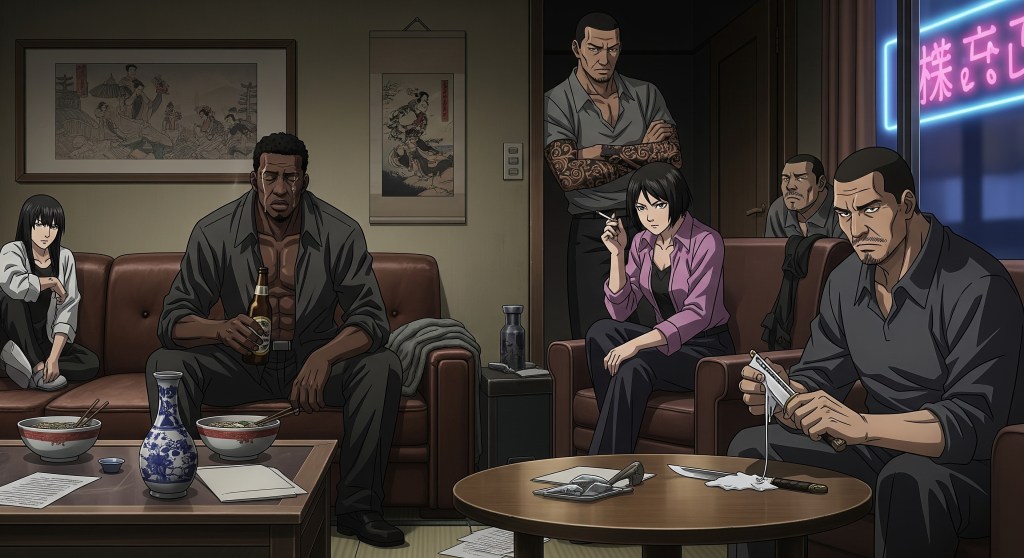
しごと を おえて、いえ に かえって、ビール を のんだ。
Shigoto o oete, ie ni kaette, biiru o nonda.
I finished my work, went home, and drank a beer.

The -te form is like your homie, the one who introduces you to the next cat. It’s what you use to connect two or more verbs, showing that one action happened, and then another one came right after it. It’s the “and then” or the “after doing something” of the Japanese street talk. It’s how you lay out a sequence of events, like “I went to the store, and then I bought some snacks, and then I went home.” One thing after the other, straight and to the point.
| Verb Group | Rules | -te Form | |
| Group 1 (-u verbs) | -u, -tsu, -ru | Drop the ending, add -tte | かう kau → かって katte buy and |
| -mu, -bu, -nu | Drop the ending, add -nde | のむ nomu → のんで nonde drink and | |
| -ku | Drop the ending, add -ite | きく kiku → きいて kiite listen and | |
| -gu | Drop the ending, add -ide | およぐ oyogu → およいで oyoide swim and | |
| -su | Drop the ending, add -shite | はなす hanasu → はなして hanashite talk and | |
| Group 2 (-ru verbs) | Drop the -ru, add -te | たべる taberu → たべて tabete eat and | |
| Group 3 (Irregular) | する | Change to -shite | する suru → して shite do and |
| くる | Change to -kite | くる kuru → きて kite come and |

Peep these sentences before you run the examples.
さわぐ (Sawagu)
English: To make a fuss; to be rowdy.
Man, you know how it is. You and your boys are celebrating a big score, poppin’ bottles, and the music is blastin’. The neighbors start callin’ the cops ’cause you’re bein’ too loud. That’s what this word is. It’s when you’re makin’ a ruckus, gettin’ wild, and attractin’ all the wrong kinda attention.
びこう する (Bikou suru)
English: To tail; to follow.
When you need to keep tabs on somebody without them knowin’ it, you gotta be slick. You’re in the shadows, stayin’ a couple of cars back, watchin’ their every move. That’s what a stakeout is, straight up. Just like how the FBI be tailin’ a suspect in all them gangster flicks.
すてる (Suteru)
English: To get rid of; to abandon; to ditch.
Sometimes you gotta cut ties with something or someone that ain’t doin’ you no good. Maybe it’s a ride you used for a hit, and you gotta ditch it so the heat don’t find it. Or maybe it’s some old homie who’s talkin’ too much. Whatever it is, you gotta drop it like it’s hot.
たま を そうてんする (Tama o souten suru)
English: To load a gun; to chamber a round.
Before you go handle business, you gotta prep your tool. You’re slidin’ the clip into the handle, then rackin’ that slide to make sure there’s a round in the chamber, ready to go. You gotta be ready for whatever, so you make sure your piece is primed and ready.
うばう (Ubau)
English: To rob; to snatch; to steal.
This is when you take somethin’ from somebody else, straight up. Whether it’s money, jewelry, or a car, you just go in and take it. It’s like when John Dillinger and his crew would hit up banks back in the day, or when you see a character in a movie stickin’ up a corner store.
Here’s how we lay it down, linking our actions like a proper crew.
さつ が きた から、ぶつ を かくして、にげた。
Satsu ga kita kara, butsu o kakushite, nigeta.
The cops came, so I hid the goods and ran.
てき の じむしょ に いって、やつ を しめて、かね を うばった。
Teki no jimusho ni itte, yatsu o shimete, kane o ubatta.
I went to the rival’s office, beat him up, and stole the money.
あいて を だまして、もうけて、あたらしい くるま を かった。
Aite o damashite, mookete, atarashii kuruma o katta.
I tricked the guy, made a profit, and bought a new car.
たま を そうてんして、まど を あけて、そと を みた。
Tama o sooten shite, mado o akete, soto o mita.
I loaded the bullets, opened the window, and looked outside.
やつら が きた から、けいたい を すてて、かくれた。
Yatsura ga kita kara, keitai o sutete, kakureta.
They came, so I threw away my phone and hid.
なかま と さけ を のんで、さわいで、あさ まで はなした。
Nakama to sake o nonde, sawaide, asa made hanashita.
I drank with my boys, partied hard, and talked ’til morning.
ぶつ を うって、かね を かせいで、クラブ に いった。
Butsu o utte, kane o kaseide, kurabu ni itta.
I sold the goods, made some money, and went to the club.
おやぶん に あいさつして、ほうこく を して、しじ を まった。
Oyabun ni aisatsu shite, hookoku o shite, shiji o matta.
I greeted the boss, reported to him, and waited for orders.
ターゲット を さがして、みつけて、びこう した。
Taagetto o sagashite, mitsukete, bikoo shita.
I looked for the target, found him, and tailed him.
へや に はいって、かぎ を しめて、しずか に まった。
Heya ni haitte, kagi o shimete, shizuka ni matta.
I went into the room, locked the door, and waited quietly.
Word is bond, my G’s. Stay sharp, stay real. The streets are watchin’.


Leave a comment